Also on the truck
The rest of the lineup.
Same $99 diagnostic, same written quote, same written warranty on every machine we fix in Meridian.
Meridian’s city wells deliver water that leaves scale on everything it touches, and the washer inlet valve is where it shows up first: slow fills, a cycle that times out, an error code nobody can look up.
Same $99 diagnostic, same written quote, same written warranty on every machine we fix in Meridian.
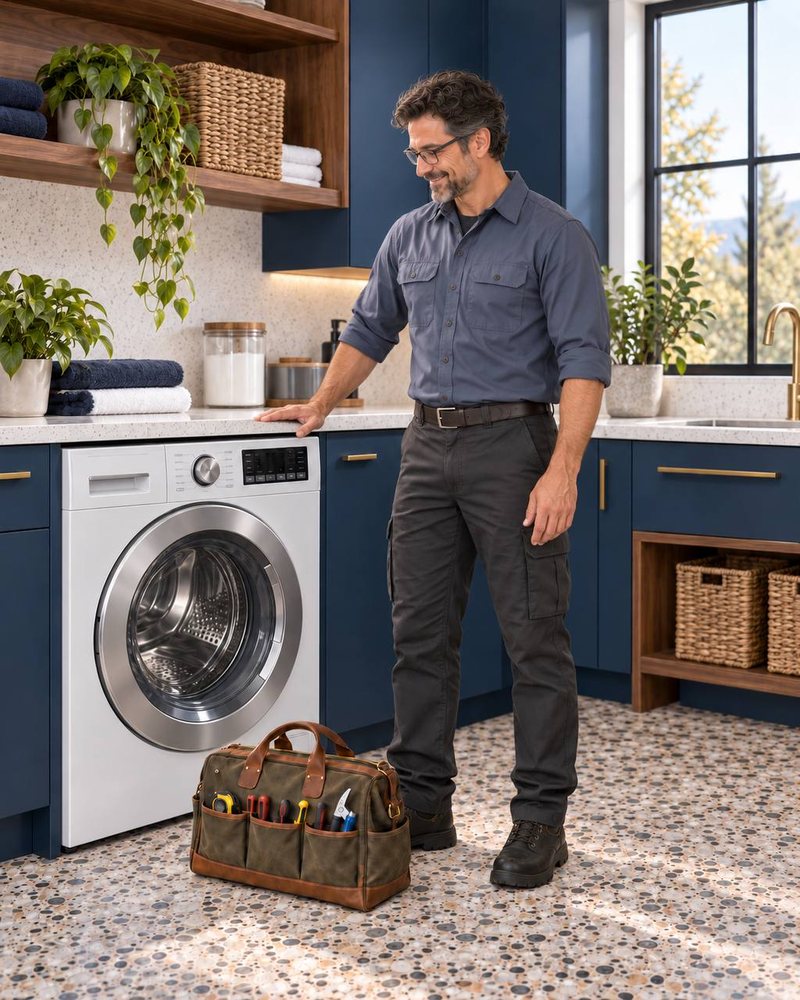
Hard water is the first thing to understand about a Meridian washer. The city draws from deep wells, and what comes out of the tap carries enough dissolved mineral to narrow an inlet valve over a few years of daily loads. Plenty of homes in Paramount and Bridgetower have a softener in the garage, which helps right up until the salt runs out. Our shop is on Overland Rd near Eagle Rd, so the south side is a short run and the north side is straight up Eagle Rd or Locust Grove, and the $99 diagnostic is the same price it is anywhere else in the valley. No distance surcharge.
The other Meridian pattern is the builder package. When a subdivision like Tuscany or Lochsa Falls was finished, hundreds of houses got the same front-load washer in the same month, and those machines age on the same clock. So we see the same fault repeating along a street: door locks that stop latching, drain pumps clogged with a hair tie and a sock, shock absorbers that let the drum bang the cabinet on spin. Picture a Saturday morning in a two-story near Settlers Park, the washer upstairs full of water and showing a drain code. We come with the pump on the truck.
The inlet valve screens and the valve itself are narrowed by scale. We pull the hoses, check pressure at the tap, clean or replace the screens and test the valve solenoids with the meter. If the valve is restricted internally it gets replaced. We also ask about your softener, because an empty salt tank explains a lot.
Nine times out of ten it is the drain pump or something caught in front of it: a sock, a bra wire, a child’s hair clip. We open the pump housing, clear it, and test the pump motor. A drain hose kinked behind the machine or pushed too far into the standpipe causes the same symptom, so we check that.
A front-loader that refuses to spin may have a failing motor control board, worn bearings, or simply an unbalanced load it keeps trying to correct. A top-loader may have a broken lid lock or a stretched belt. We run the spin test in service mode and meter the motor windings before quoting.
Front-load door boots crack and hold grit; top-load tub seals and inlet hoses give out; drain pump housings weep at the seam. We find the source with the machine running, not by guessing from the puddle. On upstairs laundry rooms in Meridian two-stories we also check the drain pan and its outlet.
Suspension rods on a top-loader or shock absorbers on a front-loader have lost their damping, and on a stacked pair the whole tower shakes. We replace the set, level the machine on the laundry room floor and confirm the feet are locked. Loose concrete counterweights get checked while the cabinet is open.
Front-load door locks fail electrically more than mechanically, leaving wet clothes trapped. We release the door manually, meter the lock assembly and the wiring to the board, and replace the lock. Codes get photographed and matched to the fault we actually measure, since the code is only the machine’s first guess.
We start where the water starts. The supply hoses come off and we look at the inlet screens, because in Meridian they are often half blocked with white grit and that alone can cause a fill error. Then the meter comes out: valve solenoids, drain pump, motor, door lock and the wiring between them and the control board. On front-loaders we run the built-in service cycle so the machine shows us each stage under load. If the fault is a scaled valve, we say so and mention the softener. If it is a pump packed with lint and a sock, you get to see the sock. Then one written price for the whole job.
Meridian laundry rooms hold Samsung and LG front-loaders from the Eagle Rd big-box stores, Whirlpool and Maytag top-loaders from the earlier Paramount and Bridgetower phases, and GE, Kenmore, Amana and Electrolux scattered through the rental stock near The Village at Meridian. Speed Queen turns up in homes where someone got tired of replacing machines. We carry the common wear parts for all of them. Landlords get the tenant visit, the text approval and the written invoice and warranty by email. The $99 diagnostic is inside the price you approve; if you decline, $99 is the whole bill. Every price comes after the diagnostic, and it comes in writing, never as a guess over the phone.
It shortens the life of the inlet valve and screens, and it leaves a film on the door boot and drum that traps grit. A working softener slows all of that down. If your Meridian home has a softener, check the salt when the washer starts filling slowly, then call us to look at the valve.
Usually. Drain pumps for the common brands are on the truck, and most drain codes come down to a clogged pump housing or a failed pump motor. We clear it, test it and run a full drain and spin before we leave. If the board itself has failed, we order the part and come back with no second trip fee.
The tenant lets us in, we diagnose and send you the written price by text, you approve, and we fix it while we are there. The invoice and written warranty come to you, not the tenant. Many Meridian landlords never see the machine, and that is fine with us.
Often, yes. A pump, valve or door lock is a small part on a machine that otherwise has years left. When the fault is a drum bearing or a main board on an older unit we tell you plainly, and you can decide with the written number in front of you. No pressure either way.
The $99 diagnostic, and that is all. You will know what failed and why, in writing, and you can use that when you shop for a replacement. If you do go ahead with the repair, the $99 is already inside the written price rather than added on top.
Tell us the machine and what it is doing. We call back with a real window — and the $99 diagnostic is already inside the written price you approve.