Also on the truck
The rest of the lineup.
Same $99 diagnostic, same written quote, same written warranty on every machine we fix in Meridian.
The oven is set to 400, the timer says preheated, and the thermometer you bought says 340. Or a gas burner clicks and clicks before the flame catches.
Same $99 diagnostic, same written quote, same written warranty on every machine we fix in Meridian.
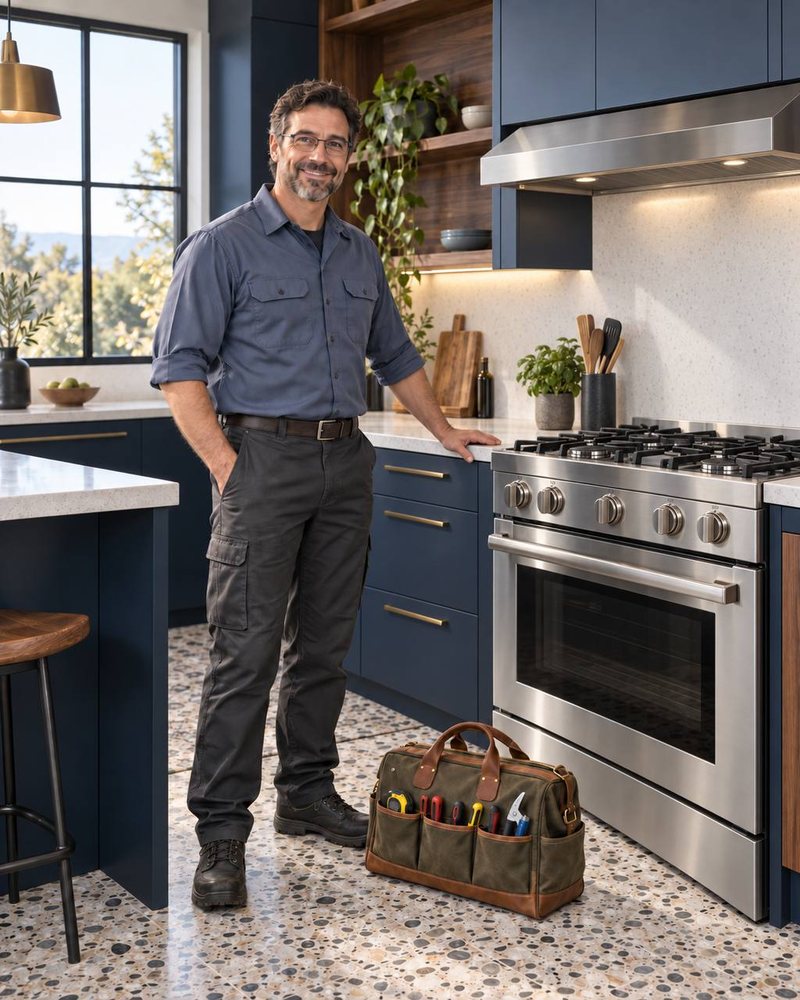
Meridian’s kitchens were built in phases, and each phase had its favorite range. The 2000s streets of Paramount and Bridgetower got freestanding electric coil and early glass-top ranges. Lochsa Falls and Tuscany moved toward gas as builders ran lines to the kitchen. The newest homes off Ten Mile Rd and around Ten Mile Crossing are slide-in gas or induction with a separate wall oven. We work on all of it from our own shop on Overland Rd near Eagle Rd, a short run to the south side and straight up Eagle Rd or Locust Grove to the north. Same $99 diagnostic as anywhere in the valley, no distance surcharge.
The failure that gets Meridian on the phone is the oven that will not hold temperature. A bake igniter on a gas oven weakens gradually; it still glows, but it no longer draws enough current to open the gas valve, so the oven lights late or not at all. On electric ovens the bake element cracks or the temperature sensor drifts, and the oven bakes forty degrees off without saying a word. We see a run of these every November, usually in the same subdivision, because the ranges were all installed the same year. The fix is a part on the truck and a calibration check.
The spark module is working, so the problem is at the burner: a wet or cracked igniter electrode, a burner cap sitting crooked after cleaning, or ports blocked with boiled-over food. If all burners click without lighting, the spark module or its ground has failed. We test each and replace only the piece that failed.
On gas, a weak bake igniter that glows but draws too little current to open the valve. On electric, a bake element with a visible break or a temperature sensor reading wrong. We meter the igniter amperage, check element resistance and sensor ohms against the chart, then verify with a thermometer after the repair.
Usually the convection fan has stopped, the bake or broil element is partly failed, or the door gasket has a gap letting heat escape at one corner. We run the oven, watch the elements glow, meter the fan and check the seal. A range that was never leveled on its anti-tip bracket can also bake crooked.
A radiant element has burned through, or the infinite switch behind the knob has failed and is either open or welded closed. A switch stuck on high is a hazard, so we treat that as a priority call. We meter the element and the switch and replace the failed one from the truck.
The code is the control board’s report, not the diagnosis. F1 and F3 style codes usually point to a temperature sensor or the board itself; door lock codes point to the latch motor after a self-clean. We photograph the code, meter the sensor and lock and confirm the fault before quoting.
A yellow flame means poor air mixture or a partly blocked burner; a gas smell while the range is off means a fitting or the valve. Shut the supply valve, ventilate and call. We check the regulator, the flex connector and every burner valve with a detector before it is used again.
A range diagnosis has two halves. First, the supply: is the gas valve fully open, is the flex line sound, are both legs of a 240-volt circuit live at the outlet behind an electric range. Half the ranges that look dead are a tripped breaker or a valve someone bumped during a kitchen remodel. Second, the machine itself. We pull the oven floor or back panel and put the meter on the bake and broil igniters or elements, the temperature sensor, the convection fan and the surface switches or spark module. Each reading is compared with the manufacturer’s spec. You hear the failed part in plain words and receive one written price.
Meridian ranges are mostly Whirlpool, GE, Frigidaire and Samsung from the builder packages, with LG and KitchenAid in the upgraded kitchens of Bridgetower and Tuscany and Bosch slide-ins in the newest streets near The Village at Meridian. We also handle the older Kenmore and Maytag units that came with a used house. For rentals, the tenant meets us and the owner approves by text; a range that does not light is a habitability issue, so we move quickly. The $99 diagnostic is inside the repair price you approve, and a declined repair costs $99 and nothing more. Nothing is priced until after the diagnostic, and then it is in writing.
Almost certainly a weak bake igniter. It glows, so it looks fine, but it no longer pulls enough current to open the gas safety valve on time. We meter the amperage, replace the igniter and then check the oven against a thermometer so your Meridian kitchen bakes at the temperature the dial says.
Yes. Many newer Meridian homes have a gas cooktop on the island and an electric wall oven in the cabinets. We service both, including the double wall ovens in the larger Tuscany and Ten Mile Crossing homes, and we bring the elements, sensors and igniters that fit them.
Usually in one visit. A dead zone on a glass cooktop is a radiant element or the infinite switch that controls it, both of which we carry for the common brands. If the glass itself is cracked we tell you in writing what that involves so you can decide.
No. Turn the shutoff valve behind the range or at the meter, open a window and call. We check the regulator, the flex connector, the manifold and each burner valve with a gas detector, and the range is not used again until it passes. Gas repairs are quoted in writing like every other repair.
You pay $99 for the diagnostic, and that $99 is part of the written repair price if you say yes. It is not added on afterward. If you decide not to repair, $99 is the whole bill and you keep the written diagnosis, which is useful when shopping for a new range.
Tell us the machine and what it is doing. We call back with a real window — and the $99 diagnostic is already inside the written price you approve.