Also on the truck
The rest of the lineup.
Same $99 diagnostic, same written quote, same written warranty on every machine we fix in Meridian.
Two cycles for one load of towels, a drum that squeals down the hall, a gas dryer that tumbles cold. Meridian dryers give plenty of notice before they quit.
Same $99 diagnostic, same written quote, same written warranty on every machine we fix in Meridian.
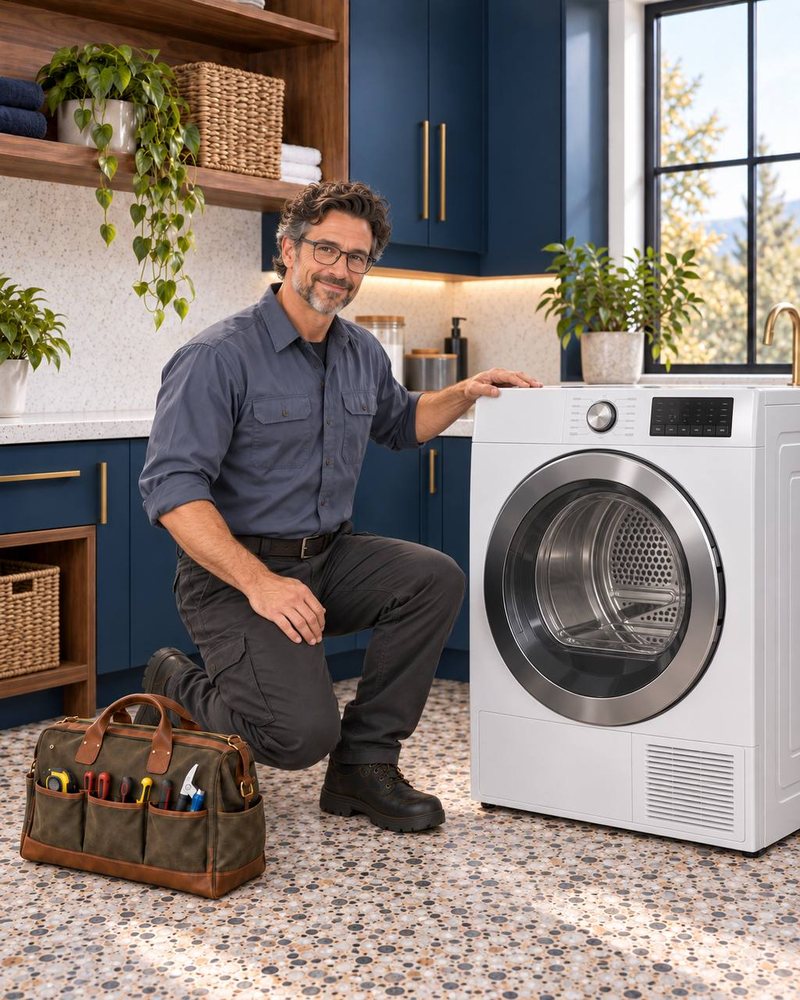
Meridian grew faster than any city in Idaho, and its dryers were installed in waves. Paramount and Bridgetower went in through the 2000s, Lochsa Falls and Tuscany filled out after that, and Ten Mile Crossing is still pouring foundations. Each wave got a builder-grade laundry pair, so the calls come in clusters: one street’s dryers start losing heat within a year or two of each other. Meridian is our own town: the shop is on Overland Rd near Eagle Rd, and we reach the north side up Eagle Rd or Locust Grove and the south side along Overland, Victory and Amity. No distance surcharge, and the $99 diagnostic is the same as it is in Boise.
What fails here is shaped by how these homes were built. A two-story in Lochsa Falls often has its laundry room upstairs, which means the vent runs across the attic before it finds daylight, and the fine dust that blows in off the farmland west of Linder Rd settles into every foot of it. A choked vent makes the dryer overheat, the thermal fuse blows to protect it, and you get a drum that turns with no heat at all. The other Meridian pattern is the rental: a tenant near The Village at Meridian reports a damp load, the property manager texts us, and we handle the rest.
On an electric dryer this is usually the heating element or the thermal fuse, and the fuse rarely blows without a reason, so we check the vent too. On gas, the igniter glows but the flame sensor or gas coils have quit. We meter each part, replace the failed one from the truck and confirm airflow before we leave.
Almost always airflow. The lint screen looks fine, but the vent behind the wall or across the attic is packed with lint and Meridian dust. We measure airflow at the exhaust, clear the run, check the moisture sensor bars for residue and reset the cycle so the dryer stops when the clothes are dry, not when the timer runs out.
Drum rollers, the idler pulley or a glazed belt. The squeal gets louder as the dryer warms up and the thump comes once per rotation. We pull the front panel, spin each roller by hand, replace the worn set and the belt together, and run a full cycle so the noise is gone before we pack up.
A dryer that stops early is protecting itself. We look for a cycling thermostat opening too soon, a motor that is overheating because the vent is blocked, or a door switch that flickers when the drum vibrates. The meter tells us which one, and the fix is usually one part plus a clean vent.
First the outlet. A 240-volt dryer in a Bridgetower garage can lose one leg at the breaker and look dead. If power is there, it is the thermal fuse, the door switch, the start switch or the control board. We test in that order and quote the actual failed part, not the most expensive one.
Stop using it and call. Lint has usually built up inside the cabinet around the heater housing or burner, or the vent is so restricted that the exhaust temperature has climbed past what the machine was designed for. We clean the interior, clear the vent and check the high-limit thermostat before we let it run again.
The diagnosis starts at the wall. We confirm the dryer is getting the voltage it needs, then open the cabinet and put the meter across the heating element, the thermal fuse, the cycling and high-limit thermostats and, on gas models, the igniter, flame sensor and gas valve coils. Each of those reads either good or failed; there is no guessing. While the cabinet is open we look at how much lint has collected inside, because that tells us how the vent has been behaving for the last few years. Then we go outside, find the vent hood and measure airflow. You get the failed part named in plain words and one written price.
Meridian laundry rooms are full of Whirlpool, Maytag, Samsung, LG and GE pairs from the big-box stores along Eagle Rd, plus Kenmore and Amana in the older Paramount phases and Speed Queen where someone bought for the long haul. We stock the common parts for all of them. For landlords with houses in Tuscany or near Settlers Park, the tenant meets us at the door, you approve the written number by text and the invoice and written warranty come to you. The $99 diagnostic is inside the repair price you approve, and if you turn the repair down, $99 is the whole bill. All pricing comes after the diagnostic, in writing.
On electric models the heating element or thermal fuse has opened, and on gas models the igniter, flame sensor or gas coils have failed. A blown fuse almost always points back to a restricted vent, which is common in Meridian’s two-story homes with attic vent runs. We replace the part and clear the vent so the new part lasts.
We measure airflow on every dryer visit and clear the run when it is restricting the machine, because a new element or fuse behind a packed vent will fail again. If the vent needs more than a clearing, we tell you in writing what we found so you can decide.
Both. Gas dryers are common in Meridian’s newer subdivisions where builders ran gas to the laundry room, and we carry igniters, flame sensors and gas valve coils on the truck. We also confirm the gas shutoff and flex line are sound before we leave.
Usually within the week and often next day. Meridian is our own town, with the shop on Overland Rd, and we run early and late windows for shift workers at Micron, St. Luke’s and the airport. Tell us what the dryer is doing when you book and we bring the likely parts.
The diagnostic is $99, and that amount sits inside the written repair price you approve, so you are not paying for the visit and then the repair on top. If you decide not to go ahead, $99 is the entire bill. We do not quote repair prices over the phone because we have not seen the dryer yet.
Tell us the machine and what it is doing. We call back with a real window — and the $99 diagnostic is already inside the written price you approve.