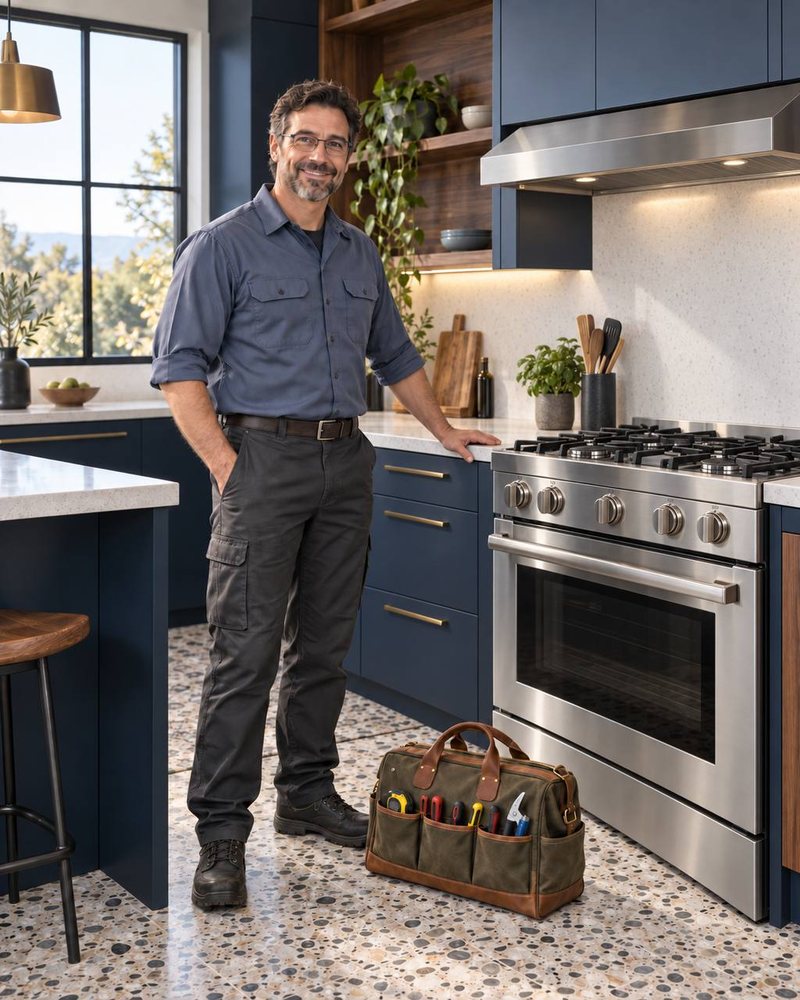
GE appliance repair in Boise from the Bench to Eagle
GE ranges are in more Treasure Valley kitchens than any other stove, from the coil-top in a 1978 Bench ranch to the Café double oven in an Eagle remodel, and GE refrigerators and top-load washers follow close behind.
GE has been the default range in Boise for fifty years. The 1970s and 80s ranches on the Bench and in West Boise still cook on GE coil-top electrics, the 1990s and 2000s subdivisions in Meridian and Southeast Boise got GE glass-tops and gas ranges from the builder, and the last decade brought Profile and Café slide-ins, double wall ovens and induction to Eagle and North End remodels. GE side-by-side and bottom-freezer refrigerators sit in many of those kitchens, and GE top-load washers and dryers fill Nampa and Caldwell rentals. What fails is consistent: bake elements and oven sensors, evaporator fans and defrost heaters, lid locks and mode shifters, dryer elements and belts, dishwasher drain pumps and scaled heaters.
The Treasure Valley leaves its fingerprints on GE machines as it does on every brand. Hard water in Boise, Meridian and Kuna scales the inlet screens on a GE washer until fills run slow, narrows the fill valve on a GE ice maker until cubes come out thin and cloudy, and coats the heater in a GE dishwasher until glasses turn chalky, especially where the softener ran dry. GE refrigerators in a Bench garage stop cycling when a December inversion drops the garage below forty and labor when August passes ninety-five. Dust from construction along Ten Mile Rd and the fields around Nampa mats the condenser coil. Summer storms leave PF blinking on GE displays across the valley.
GE faults we see most
Machine
Common symptom
What it usually is
What we do
Washer
Lid lock light flashing and no spin, or fills slowly and times out
Lid lock assembly, mode shifter or drive belt worn; inlet screens scaled
Meter the lock and shifter, replace from truck stock, clean or replace the inlet valve, run a cycle
Dryer
Runs cold, or clothes take two cycles and the cabinet is hot
Heating element or thermal fuse open; vent restricted; belt or roller worn
Meter the element, fuse and thermostats, replace, clear the vent, confirm airflow and heat
Refrigerator
Fresh-food side warm, frost on the freezer back wall, PF on the display
Evaporator fan or defrost heater failed; main board relay stuck; power interruption logged
Meter the defrost circuit and fan, test the board outputs, replace the failed part, log temperatures
Range / oven
Oven cold, bakes uneven, or F2, F3 or F7 on the control
Bake element open, oven sensor drifted, keypad membrane shorted, door lock circuit fault
Meter the element and sensor, check the keypad and lock, replace, verify oven temperature
Dishwasher
Water left in the tub, cloudy glasses, or the lights blink and nothing runs
Drain pump or check valve blocked; heater scaled; door latch switch or control not registering
Clear the drain, descale and meter the heater, test the latch and control, run a full cycle
Ice maker
No ice, thin cubes, or the tray fills but never harvests
Fill valve scaled, fill tube frozen, ice maker module or mold thermostat failed
Replace the valve, correct the fill path, replace the module, verify a complete harvest
GE error codes worth photographing
Code
What it means
What we do
F2
Range oven over-temperature, the control saw a temperature above its limit
Meter the oven sensor, check the bake relay for sticking, replace the sensor or relay board
F3 / F4
Range oven sensor circuit open or shorted, the control has no valid reading
Read the sensor resistance at room temperature, inspect the harness, replace the sensor if off
F7
Range keypad or control fault, a key reads as stuck or shorted
Disconnect and test the keypad ribbon, dry any spill, replace the membrane or control if it repeats
F9
Range door lock circuit fault, the lock did not reach its position
Test the lock motor and switches, clear the latch path, replace the lock assembly if it fails
PF
Refrigerator power failure, the display is reporting an interruption
Clear the code, verify the compressor and fans restarted, meter the board if the box stays warm
LdL
Top-load washer lid lock fault, the lid did not lock or unlock
Meter the lid lock assembly and strike, check the harness and control output, replace the lock
How GE appliance repair goes with us
A GE diagnosis starts with the display, but GE machines are less chatty than some brands, so the meter does the talking. A range showing F2 gets its oven sensor read against a thermometer and its bake relay checked before we name a part; a washer flashing its lock light gets the lock, the strike and the control output tested. Many GE dishwashers signal trouble with blinking lights rather than a code, so a photo of the panel when you book helps us load the truck. Truck stock for GE runs to bake and broil elements, oven sensors, igniters, lid locks, mode shifters, dryer elements and fuses, evaporator fans, defrost heaters, ice maker modules and fill valves. Boards and keypads are ordered by model, with no second trip fee.
GE Profile and Café machines in Eagle and the North End are often young enough to have some maker coverage left, and store extended plans cover plenty of the GE sets in Meridian and Nampa. We say so at the door when the diagnosis lands on a part that may be covered, and the failed part goes in writing so you can use the plan, or we complete the repair if you would rather not wait. For the thirty-year-old coil-top on the Bench and the fifteen-year-old side-by-side in Caldwell, we simply fix them. The rule is the same for every GE call: the $99 diagnostic is inside the written repair price you approve, it is the whole bill if you decline, and all pricing follows the diagnostic, in writing.
For GE, Profile and Café machines anywhere in the valley, the $99 diagnostic is part of the written repair price you approve, you get a single number, and the repair carries a written warranty. Book a repair →
GE questions
My GE oven shows F2 and shuts off. Is the range finished?
Almost never. F2 means the control saw an oven temperature past its limit, and the common cause is an oven sensor that has drifted out of range or a bake relay that stuck on. We read the sensor against a thermometer, check the relay board and replace what has failed. A GE range from the 1990s with a new sensor bakes as evenly as it ever did.
Do you repair the old GE coil-top ranges on the Boise Bench?
Yes, gladly. Coil-top GE ranges from the 1970s and 80s are among the simplest machines we see: surface elements, infinite switches, bake and broil elements, a sensor or thermostat. Parts remain available and the repairs are usually one visit. If a part has gone out of production we tell you so before quoting, not after.
My GE refrigerator is blinking PF after a storm. Do I need a repair?
Not necessarily. PF means the refrigerator lost power and is telling you so, and if the box is cold again the code clears with a press. Call us if the compressor or fans did not restart, or if the fresh-food side stays warm, because a surge can damage the main board or a fan motor. We meter both before naming a part.
Are you a GE factory service company?
No. We are an independent Treasure Valley repair shop that services and repairs GE, GE Profile, Café and Hotpoint appliances across the Treasure Valley. We work the same way on a GE as on anything else, a meter-first diagnosis and one written quote, and our written warranty covers the repair we perform. If GE coverage may apply, we tell you.
Can you fix a GE top-load washer that fills but will not spin?
Yes, and it is one of our most common GE calls in Nampa and West Boise rentals. On these washers the lid lock assembly or the mode shifter has usually failed, and the lock light flashes or the machine shows LdL. We meter both, check the belt and the control output, replace from the truck and run a full wash and spin before leaving.
Book GE service.
Tell us the machine and what it is doing. We call back with a real window — and the $99 diagnostic is already inside the written price you approve.
 Dryer Repair$99 finds the fault · figure on paper
 Washer Repair$99 finds the fault · figure on paper
 Fridge & Freezer Repair$99 finds the fault · figure on paper
 Stove & Oven Repair$99 finds the fault · figure on paper
 Dishwasher Repair$99 finds the fault · figure on paper