Also on the truck
The rest of the lineup.
Same $99 diagnostic, same written quote, same written warranty on every machine we fix in Boise & the Treasure Valley.
An oven that preheats forever and then bakes cold in the middle, a gas burner clicking without a flame, a glass-top with one zone that never glows, a wall oven flashing an F-code the week of Thanksgiving.
Same $99 diagnostic, same written quote, same written warranty on every machine we fix in Boise & the Treasure Valley.
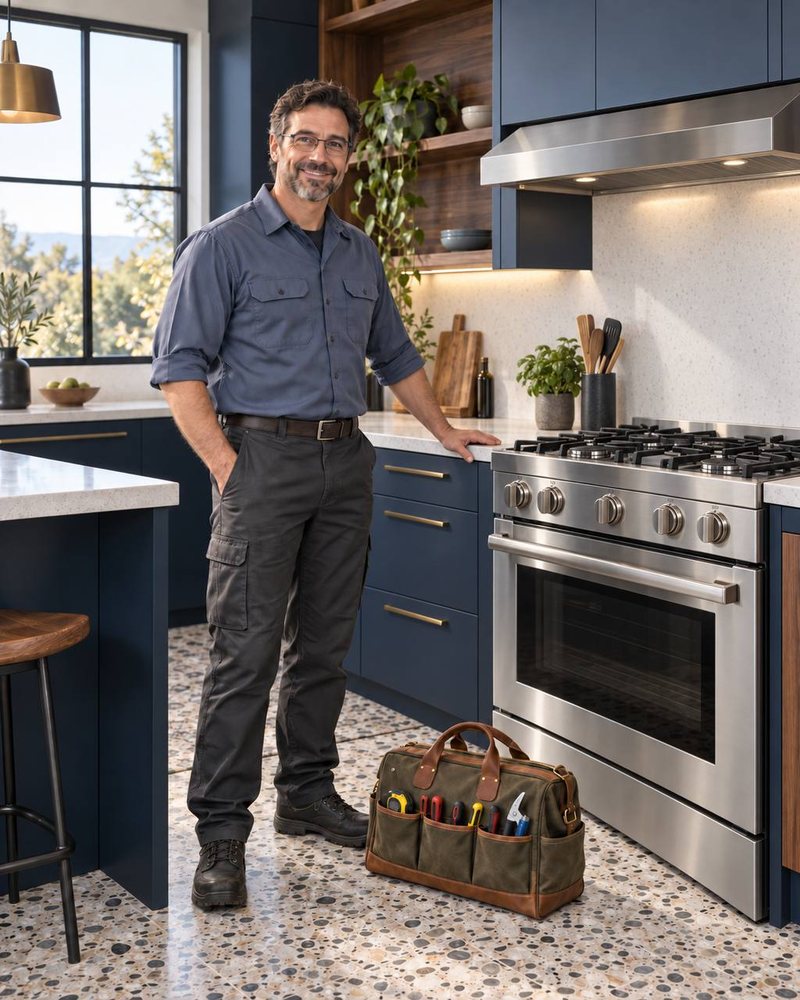
The kitchens we cook in vary more than any other room. North End and East End bungalows off Harrison Blvd and Warm Springs Ave hide retrofitted gas ranges in 1930s footprints. West Boise and Bench ranches run coil-top electrics that have outlived two dishwashers. Meridian, Star and Kuna subdivisions carry glass-top slide-ins from a builder package, and Eagle and Harris Ranch kitchens hold Wolf, Thermador and Viking ranges that deserve a technician who has opened one before. Our trucks leave the shop at Overland and Eagle Rd and reach all of it, east on Overland to the Bench and I-84 to Southeast Boise, up Eagle Rd to Garden City and Eagle, or west along I-84 to Nampa and Caldwell, for the same $99 diagnostic.
Ovens in the valley fail on a schedule the calendar sets. The first cold week in November, everyone bakes again, and the igniters that spent the summer glowing a little weaker than they should finally cannot open the gas valve. In electric ovens the bake element develops a bright spot and then a break, usually mid-preheat. A common call from a Southeast Boise kitchen: the oven display says 350, the cookies take twice as long, and the meter shows an element drawing a fraction of its rated current. We replace it, verify the temperature with our own probe, and the next batch comes out on time.
A spark igniter fouled with boil-over, a cracked ceramic insulator, a wet or misaligned burner cap, or a spark module that fires one burner and not another. We clean, gap and meter before replacing anything, because half of these need no part at all.
Gas: a weak igniter that glows without reaching the current needed to open the safety valve. Electric: a broken bake element, a failed thermal fuse or a relay on the control board stuck open. The meter separates them quickly and the common parts ride on the truck.
A temperature sensor drifting out of range, a convection fan that stopped turning, a door gasket letting heat out one side, or a control that needs its offset corrected. We measure with a probe at the center of the oven and compare to the display before deciding.
A radiant element with an open coil, a failed infinite switch or a burned relay on the control. A zone stuck on is a safety issue we treat the same day. We meter the element and switch, then quote the exact piece that failed.
Codes usually point at the sensor, the door lock on a self-clean model, a keypad with a shorted key, or the board itself. We read the code, test the part it names rather than trusting it blindly, and clear it only once the real cause is fixed.
The high heat of a clean cycle often finishes off a tired thermal fuse or lock motor. We release the door safely, meter the fuse and lock, and explain why we suggest going easy on self-clean in an older oven.
Ranges are the one appliance where we check the house first. On electric we confirm both legs of 240 volts at the terminal block, because a half-dead breaker leaves the clock lit and the oven cold and sends people shopping for a range they do not need. On gas we confirm the shutoff is open and the flex line is sound. Then the meter reads igniter current, element resistance, the oven sensor at room temperature and the switches one by one. If the complaint is temperature, our probe goes in the middle of the cavity through a full preheat, and we compare what the oven actually does against what the display claims. You get the failed part by name and one price in writing.
We service GE, Whirlpool, Frigidaire, Samsung, LG, KitchenAid, Maytag, Kenmore, Bosch and Electrolux ranges throughout the valley, and Wolf, Thermador, Viking, Dacor, JennAir and Miele in the Eagle, North End, Hidden Springs and Harris Ranch kitchens where they live. Property managers in Meridian and Nampa send us for tenant ranges, and the routine is simple: tenant present, owner approves the number by text, invoice and written warranty by email. If a part is ordered there is no second trip fee for the return visit. We never quote a repair over the phone because we have not metered it; all pricing is written after the diagnostic, with the $99 already inside.
Usually fixed. A slow preheat is most often a bake element losing resistance, a gas igniter drawing too little current, or a sensor reading low. All three are single-part repairs from truck stock on most brands. We tell you in writing which one it is and what the number is, and if the range is not worth it we say so.
Yes. We service Wolf, Thermador, Viking, Dacor, JennAir and Miele ranges and wall ovens throughout Eagle, Hidden Springs, the North End and Harris Ranch. Same $99 diagnostic, same meter-first method, and we bring the tools those ranges need to open without marring the finish.
Yes, treat it as urgent and shut off the breaker until we arrive. A radiant zone that stays on is a failed infinite switch or a welded relay, and it is a burn and fire hazard. We move these to the front of the schedule anywhere in Boise or the Treasure Valley.
Often. Codes frequently point at a sensor, a door lock or a keypad, and boards get blamed for all of them. We test the part the code names with the meter, replace only what actually failed, and clear the code once the oven completes a full preheat cleanly.
We do not publish repair prices because every failure is different and we have not seen yours. The diagnostic is $99 at any Treasure Valley address. After it, you get one written number with that $99 already inside; approve it and we repair, decline and $99 is your whole bill.
Tell us the machine and what it is doing. We call back with a real window — and the $99 diagnostic is already inside the written price you approve.