Also on the truck
The rest of the lineup.
Same $99 diagnostic, same written quote, same written warranty on every machine we fix in Boise & the Treasure Valley.
A load that comes out damp twice in a row, a drum that squeals on the first turn of the morning, a dryer that tumbles cold in a Boise garage in January.
Same $99 diagnostic, same written quote, same written warranty on every machine we fix in Boise & the Treasure Valley.
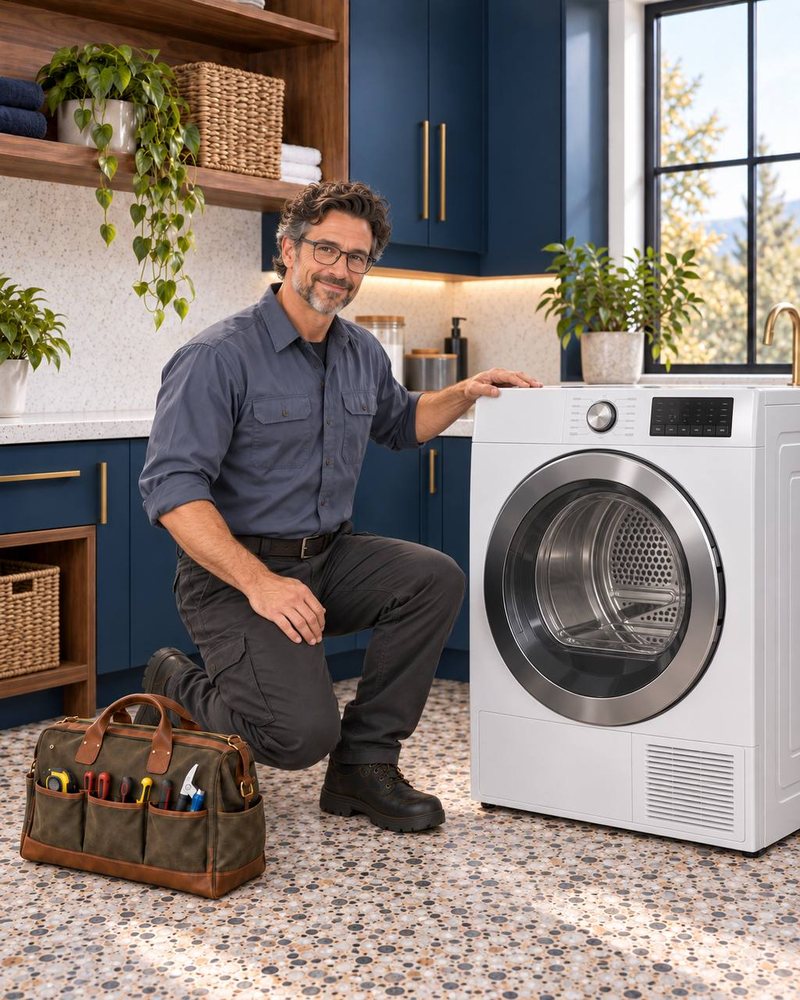
Our shop sits on Overland Rd in southeast Meridian, right at the Boise city line, and the dryers we see stretch from North End basements to Caldwell subdivisions. West Boise and the Bench run heavy on 1970s and 80s ranches with the laundry in the garage and a vent that snakes twenty feet to the roof. Meridian, Kuna and Star are builder-package territory, whole streets of the same electric dryer installed the same year. Eagle and Hidden Springs lean toward gas and higher-end pairs. We reach all of it from the same starting point, up Eagle Rd toward Chinden and State St, east on Overland or I-84 into Boise, or west on I-84 toward Nampa, and the diagnostic is the same $99 wherever the truck stops.
The Treasure Valley is a dusty place. Farm dust, construction dust from the new builds, and the fine grit the wind carries off the Owyhees all end up in the lint screen and then past it. A vent that would stay clear for years in a wetter climate packs solid here, the dryer runs hot, and a thermal fuse opens to protect the cabinet. That is the single most common reason a valley dryer suddenly runs cold. The second is plain age: a heating element or gas igniter that has quietly done twelve winters of towels and finally quits on the coldest week of the year.
Electric: a heating element with a break in the coil, or a thermal fuse that opened because the vent is restricted. Gas: an igniter that glows and quits, or flame sensor and coils that will not hold the valve open. We meter each part and tell you which one before quoting.
Almost always airflow. We measure the vent restriction, check the blower wheel for a lint cake, and look for a crushed flex hose behind the machine. Sometimes the moisture sensor bars are coated and the dryer thinks the load is dry early. Both are fixable in one visit.
Worn drum rollers, a dry idler pulley, a cracked belt or a glide that has worn through to metal. We open the cabinet, spin the drum by hand and find the noise. Rollers and belts are standard truck stock for the common brands.
A door switch that no longer clicks, a failed start switch or push-to-start relay, a blown thermal fuse, or a control board. We check power at the outlet first, then work through the circuit with the meter so nothing is replaced on a hunch.
Overheating from a packed vent that trips the cycling thermostat, a failing motor that drops out when hot, or a control that loses its mind on a specific sensor fault. We run it until it quits and catch the fault in the act.
Lint burning off the element or against the burner housing. We stop the machine, clear the cabinet, check the vent end to end and confirm the high-limit thermostat still protects you before it goes back into service. A hot smell is a call-today symptom, not a wait-and-see one.
The visit starts with a question about the vent, because the vent decides whether the repair holds. Then the meter comes out. On an electric dryer we check the outlet for both legs of 240 volts, since a tripped half of a double breaker mimics a dead element perfectly. We read the element, both thermostats and the thermal fuse for continuity. On a gas dryer we watch the igniter glow, listen for the valve, and read the coils. Belts, rollers and the idler get a hand test with the drum spinning. Before the cabinet is back together, we know the part. You get its name in plain language and one number in writing, with the $99 already counted inside it.
We repair Whirlpool, Maytag, Kenmore and Amana dryers by the hundreds, plus GE, Samsung, LG, Frigidaire, Electrolux, Bosch and Speed Queen, and the Miele and Electrolux compact pairs in Eagle and North End remodels. Landlords across Meridian and Nampa use us for rentals: the tenant opens the door, the owner gets a text with the number, approves, and receives the invoice and written warranty by email. If a part has to be ordered, we come back without a second trip fee. There are no repair prices on this page because we have not seen your dryer yet. All pricing comes after the diagnostic, in writing, and if you decline, $99 is the whole bill.
No. The diagnostic is $99 whether the truck stops in the North End or out past the Karcher Rd interchange. There is no distance surcharge and no out-of-area fee anywhere inside our thirteen Treasure Valley areas, and the written repair price is built the same way for every address.
Yes, and sooner is cheaper than later. A dryer that needs two cycles is usually fighting a restricted vent, and it will burn out a thermal fuse or element if it keeps fighting. We measure airflow, clear the machine side, and tell you in writing whether the wall-to-roof run also needs attention.
We repair gas and electric dryers in garages, basements and closets across Boise and the valley. Gas units get the igniter, flame sensor, coils and valve checked with the meter, and we confirm the flex connector and shutoff are sound before we leave.
It is. The written number you approve already contains the $99, so you are never paying a fee and then a repair on top. If you look at the number and decide the dryer is not worth it, $99 is the entire bill and you keep the diagnosis.
Same week nearly always, next day often, and we hold early and late windows for Micron, St. Luke's and airport shifts. A dryer that stopped heating during a cold snap gets priority. Tell us the symptom when you call and we will give you a real window rather than a guess.
Tell us the machine and what it is doing. We call back with a real window — and the $99 diagnostic is already inside the written price you approve.