Also on the truck
The rest of the lineup.
Same $99 diagnostic, same written quote, same written warranty on every machine we fix in Meridian.
A Meridian summer with kids in the house empties the ice bin by noon, and a fill valve narrowed by scale cannot keep up.
Same $99 diagnostic, same written quote, same written warranty on every machine we fix in Meridian.
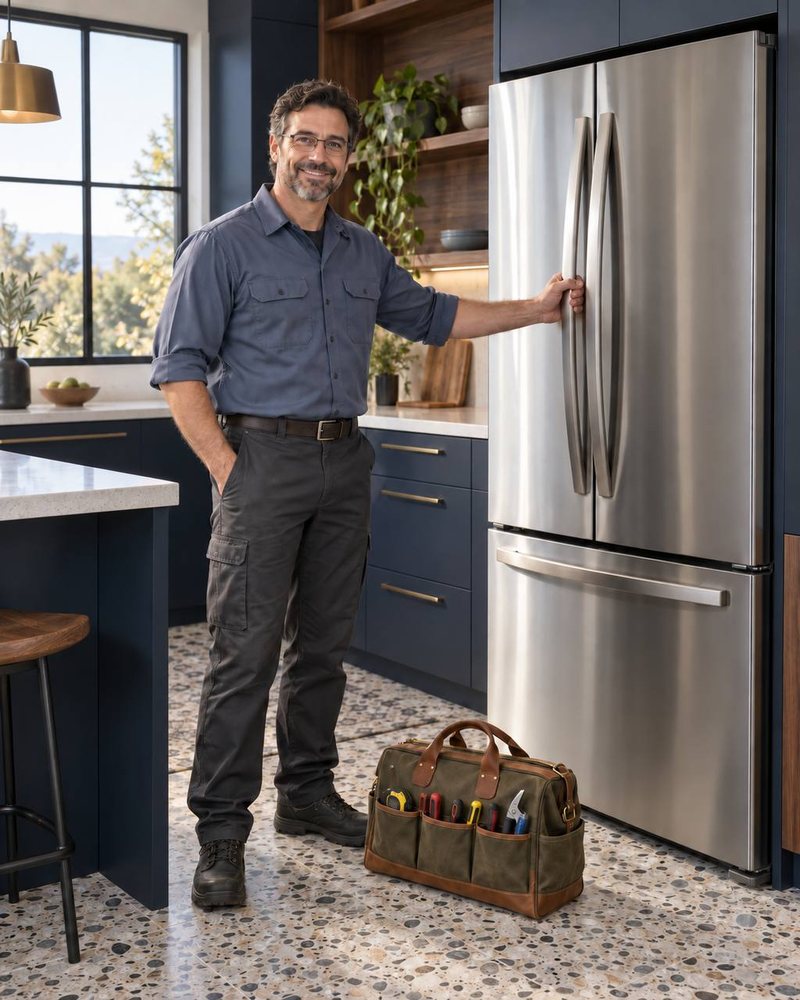
Meridian’s water comes up from wells hard enough to leave a ring in a kettle in a month, and the ice maker in your refrigerator drinks it through a valve with an opening smaller than a pencil lead. Over a few years the opening closes, the tray fills short, and you get cubes that are small, hollow and cloudy before you get none at all. It happens in Paramount, in Tuscany, in the newest streets of Ten Mile Crossing, and it happens faster when the softener is empty. Our shop is on Overland Rd in Meridian, a straight run up Eagle Rd or Locust Grove to those streets, and the $99 diagnostic is the same as it is anywhere else on the map.
The second Meridian ice maker story is the young family in a Lochsa Falls or Bridgetower two-story who filled the water dispenser twenty times a day all summer and then found the ice bin empty in September. The fill tube behind the ice maker froze solid, or the module’s ejector arm jammed on a stuck cube, or the water filter clogged and starved both the dispenser and the ice maker. Each one is a different part. We tell them apart with a meter and a look, not by replacing the whole ice maker and hoping.
First we check the shutoff arm or sensor, then whether water reaches the tray. No water points to the fill valve, the water line or a frozen fill tube. Water but no harvest points to the module motor or thermostat. We meter the valve solenoid and the module, and replace the one that has failed.
The tray is not filling fully. Scale has narrowed the fill valve, the water filter is clogged, or supply pressure is low. We measure the fill volume, test the valve, check the filter date and look at the saddle valve under the sink. In Meridian this is the most common ice call by a wide margin.
An overdue water filter, a bin of old ice absorbing freezer odors, or a food spill in the freezer. We replace the filter, dump the bin and check the door gasket and freezer temperature. If the taste persists after fresh ice, the water line itself may need replacing, and we say so in writing.
The fill valve is leaking past its seat, dribbling water into the tray between cycles, or the fill tube is dripping. Either way the tray overfills and freezes solid. We thaw it, replace the valve and confirm it seals shut with the meter before we leave.
The auger motor, the dispenser flap or its solenoid, or a bin of clumped ice from a door left ajar. We test the motor and flap, check the door switch, and clear the chute. On French-door units the ice chute door can freeze open and let warm air in, which clumps the bin.
The freezer is not cold enough, the fill valve is partly scaled, or the module thermostat is late calling for harvest. We check freezer temperature first, then fill volume, then the module cycle time. Slow ice is often the first sign of a defrost problem elsewhere in the refrigerator.
The ice maker is a small machine with a short list of parts, so we go down the list. Freezer temperature first, because a warm freezer makes no ice no matter what else is right. Then water: pressure at the supply, the filter, the fill tube and the valve, with the fill volume measured against spec. Then the module: the motor that turns the ejector, the thermostat that calls for harvest and the shutoff arm or optical sensor. Each gets a reading. In Meridian the fill valve loses most often because scale has narrowed it, and we can show you the deposit on the old one. One written number follows.
The ice makers we see in Meridian sit inside Samsung and LG French-door refrigerators, Whirlpool and Maytag side-by-sides, Frigidaire and GE bottom-freezers and Kenmore units of every age, plus KitchenAid in the upgraded kitchens of Bridgetower. We carry the fill valves and modules for the common ones. If your ice maker belongs to a rental near The Village at Meridian, the tenant meets us and you approve the written quote by text. The $99 diagnostic is inside the repair price you approve, and if you choose not to repair, $99 is the whole bill. We price after the diagnostic, in writing, never before.
Because the tray is not filling all the way. Meridian’s hard well water leaves scale inside the fill valve until the opening is too small to fill the tray in the time the module allows. A clogged filter does the same thing. We measure the fill, replace the valve or filter and check the softener.
Only the ice maker built into a refrigerator or freezer. Countertop and under-counter ice machines are a different trade. If your refrigerator’s ice maker has stopped, makes bad ice or floods the bin, that is exactly what we do, and we bring the valve and module with us.
A working softener slows the scale that narrows the fill valve, so it helps the next valve last longer. It cannot clear a valve that has already closed up; that part gets replaced. Many Meridian homes have a softener that ran out of salt months ago, so we ask.
Often, yes. Both are fed through the same filter and the same dual fill valve, so a clogged filter or one dead solenoid can drop one while the other keeps working. We test both sides of the valve and the filter housing and replace what has failed.
The diagnostic is $99, and that figure is inside the written repair price you approve, not stacked on top. We do not guess at repair prices before seeing the machine. If you decide not to go ahead, $99 is the whole bill and the written diagnosis is yours.
Tell us the machine and what it is doing. We call back with a real window — and the $99 diagnostic is already inside the written price you approve.