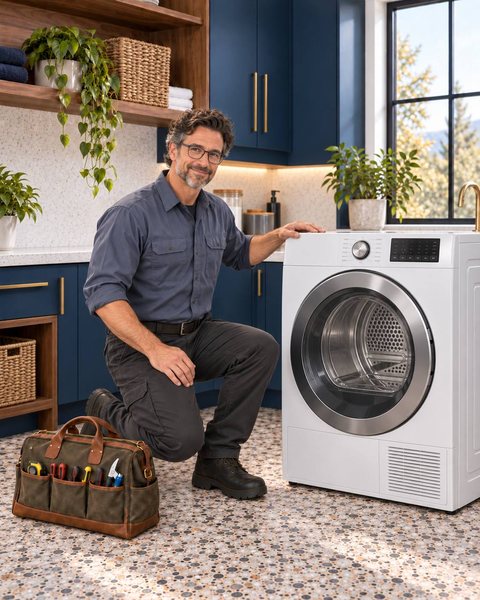
Also on the truck
The rest of the lineup.
Same $99 diagnostic, same written quote, same written warranty on every machine we fix in Downtown & North End.
Water on a basement floor off 13th St, a top-loader that fills but never spins on Warm Springs Ave, a front-loader in a downtown condo that locks its door and flashes a code.
Same $99 diagnostic, same written quote, same written warranty on every machine we fix in Downtown & North End.
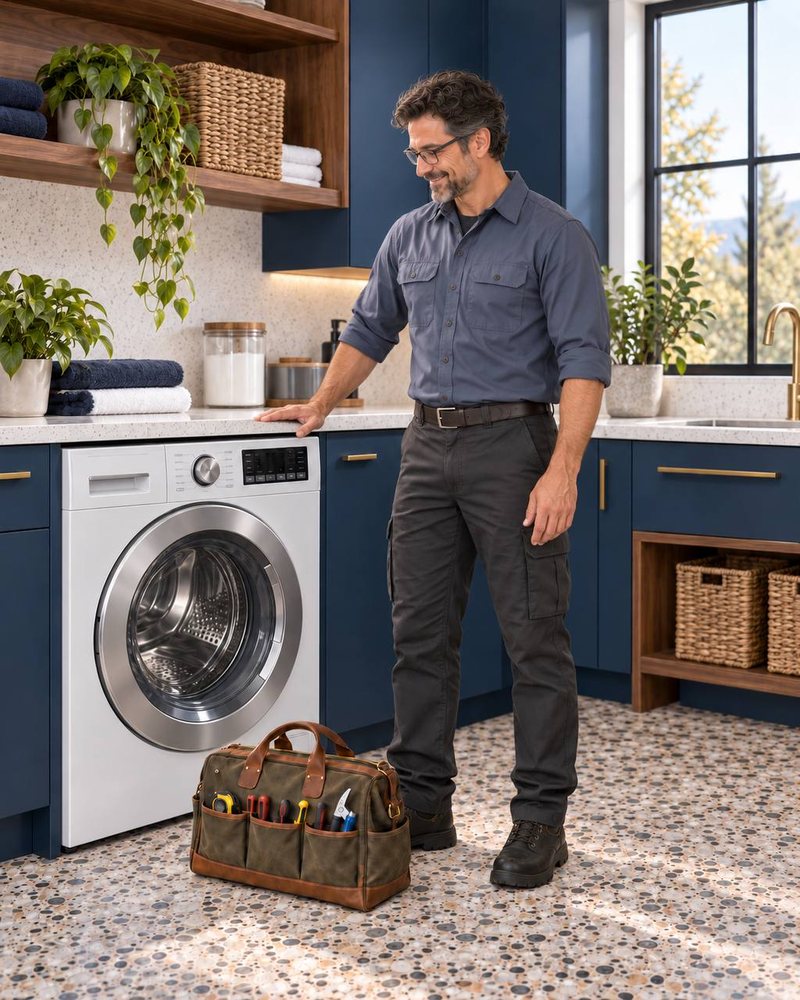
Laundry in the North End lives in the basement, reached by a steep stair beside the kitchen, under a ceiling of exposed joists. The washer drains into a standpipe or a laundry sink, the supply lines run to valves that may not have been turned in forty years, and the floor drain is the only thing between a leak and the furnace. Downtown is the opposite: compact front-loaders in condo closets over Idaho St and Bannock St, stacked with the dryer, where a leak goes straight through to the neighbor below. We come from the shop in Meridian by I-84 and the Connector, off at Myrtle or Front and up 13th or 15th, or out Warm Springs Ave for the East End, and we bring our own hoses.
Boise city water is hard, and the washer feels it first at the inlet valve, where scale narrows the ports until a fill takes ten minutes and the machine throws a supply error. Old houses add their own habits: a standpipe that is too short and lets a fast-draining front-loader siphon, a floor that slopes so the machine walks and trips its off-balance sensor, and a 1930s drain that backs up when the pump pushes lint through. Picture a Craftsman on Harrison Blvd with a Maytag top-loader that hums and will not spin. Lid switch, drive belt or a seized bearing, and the meter tells us which in a few minutes.
A hard-water problem in most of the North End. Scale closes the inlet valve screens and ports, and the control times out. We check pressure at the hose bib, clean or replace the valve, and if a softener upstairs ran dry we will say so, because the next valve will go the same way.
A sock or coin in the drain pump, a pump impeller that has broken loose, or a basement standpipe that is clogged with years of lint. We pull the pump, clear it or replace it from the truck and run a drain cycle to check the standpipe keeps up.
On a top-loader, a lid switch, drive belt or clutch. On a front-loader, a door lock that will not confirm, a motor control board or a shredded belt. We read the error history, test the lock and the motor with the meter and quote the actual part.
Fill hoses that have hardened, a door boot with a tear at the bottom fold, a pump housing with a hairline crack, or a tub seal that has finally given up. We run a fill and a spin with the cabinet open and find the water at its source, not where it puddles.
Old North End basement floors are rarely level, and a front-loader with a worn shock or a bad suspension rod will hop hard enough to move. We check the suspension, the counterweight bolts and the feet and level the machine on that particular floor.
Usually the door lock assembly, sometimes a control board that thinks water is still in the tub because the pressure hose is kinked. We release the door safely, read the code, and test the lock and pressure switch before naming the part in writing.
We start at the wall. Both supply valves open, pressure read at the hose, voltage confirmed at the outlet, because plenty of dead washers in 1920s houses turn out to be a tired basement breaker. Then the control panel gives up its error history, which on Samsung, LG and Whirlpool front-loaders points us to the right corner of the machine. The meter checks the inlet valve coils, the pump motor, the door lock and the drive motor windings. We open the cabinet only as far as the fault requires, show you the failed part, and write one number. The $99 for the diagnostic is inside that number, not on top of it.
Top-load Whirlpool, Maytag, Kenmore and Speed Queen machines are common in North End basements because they fit down the stairs; downtown condos run compact LG, Bosch and Electrolux front-loaders, often stacked. We carry parts for both and order the rest with no second trip fee. Property managers with rentals along 13th St and around the downtown core get a text with the written quote while the tenant holds the door. Pricing after the diagnostic is always in writing, never over the phone, because a washer that will not spin can be a switch or a bearing, and those are very different repairs. If you decide not to repair, $99 is the whole bill.
Almost certainly. Boise city water carries enough mineral to scale the inlet valve screens within a few years, and the flow drops until the control gives up with a supply code. We clean the screens or replace the valve and check whether a whole-house softener, if you have one, is actually doing its job.
It can, with attention to the drain. Many condo closets have a short standpipe and a fast pump, so the machine siphons or overflows. We check hose height, the drain pan and the door boot on every condo visit and fix what is actually leaking rather than replacing the machine.
Yes. Lid switches, belts, couplers, pumps and inlet valves for Whirlpool, Kenmore, Maytag and Speed Queen top-loaders stay on the truck because they fail the same way in every basement from Hyde Park to the East End. A part we have to order means one return trip and no second trip fee.
Yes, in plain words. A seized bearing on an older front-loader can run past what the machine is worth, and we say so before you approve anything. Either way you know the failed part, and the diagnostic stays at $99 if you choose not to go ahead.
No. It is folded into the written repair price you approve. You pay one number, and that number already includes the visit, the meter work and the explanation. Decline the repair and $99 is the entire bill for the trip to Downtown Boise.
Tell us the machine and what it is doing. We call back with a real window — and the $99 diagnostic is already inside the written price you approve.