Also on the truck
The rest of the lineup.
Same $99 diagnostic, same written quote, same written warranty on every machine we fix in Downtown & North End.
A dryer in a Hyde Park basement runs a full hour and the towels still come out damp. Or the drum has started squealing under the kitchen floor on Harrison Blvd.
Same $99 diagnostic, same written quote, same written warranty on every machine we fix in Downtown & North End.
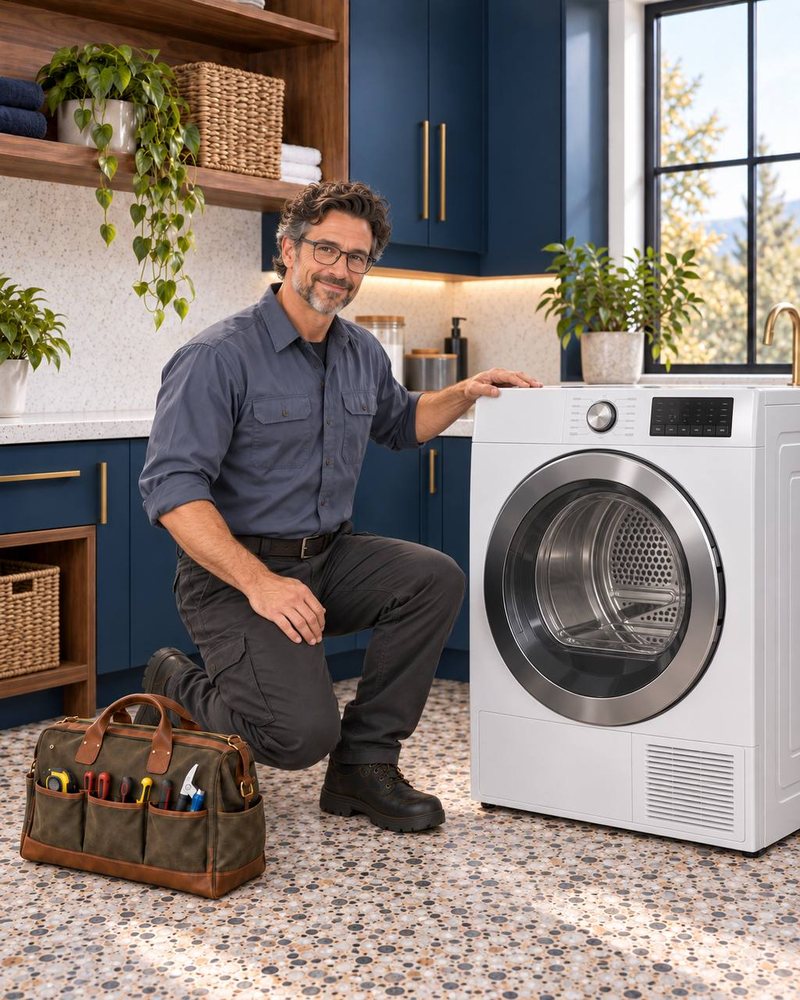
The North End and East End were built between about 1905 and 1945, and most of those bungalows and Craftsman houses put the laundry in the basement. That means a dryer vent that climbs to a window well or snakes through the joists to a side wall, a stairway that was never meant for a 27-inch machine, and wiring that has been touched by four generations of electricians. Downtown adds condos with compact stacked or ventless units. We reach 83702 from our Meridian shop by way of I-84 and the Connector, off at Myrtle or Front and up 13th St or 15th St, or along Warm Springs Ave for the East End, and park on the street or in the alley like everyone else.
What fails here is mostly about the vent and the years. A window-well hood packs with lint and cottonwood fluff from the big trees along Harrison Blvd, the airflow drops, the cycle stretches, and eventually the thermal fuse opens and the dryer runs cold. Gas dryers add igniters and gas valve coils that wear out after fifteen or twenty years, and the old house's 30-amp circuit occasionally loses a leg at the breaker, which leaves an electric dryer tumbling with no heat at all. A typical call: a Camel's Back Park neighbor whose dryer needs two cycles, a vent we clear on the spot, and a fuse we replace from the truck.
Almost always a thermal fuse, heating element or gas valve coil, and a fuse rarely opens without a reason, so we check the vent and the blower at the same time. We test each part with the meter, replace what failed from the truck and confirm the exhaust temperature before we leave.
Restricted airflow. In a basement laundry the run to the window well may be twenty feet with three elbows, and it packs with lint. We clean from the dryer to the outside hood, check the moisture sensor bars for fabric softener film and time a cycle with a real load.
Drum rollers, an idler pulley or a glide strip that has worn through. On an older Whirlpool or Kenmore the roller kit is on the truck. We open the cabinet, spin each roller by hand, replace the worn set and the belt if it is glazed, and run it quiet.
A cycling thermostat, a door switch that drops out when the drum vibrates, or a control board that resets when the old circuit sags. We watch the dryer through a full cycle with the meter on the line and find the moment it quits rather than guessing.
Door switch, start switch, thermal fuse or a tripped breaker in a panel that may be in the basement stairwell. Ventless condo units add a full water tank or a clogged condenser. We trace the start circuit end to end and name the part before quoting.
Lint that has settled on the heater housing or behind the drum, often after a vent has been blocked for a season. We clear the cabinet, check the element for a shorted coil against the housing, inspect the vent run and tell you plainly if the duct itself needs replacing.
The visit starts at the outlet or the gas valve, not at the control panel. For an electric dryer we confirm both legs of 240 volts at the receptacle, because a lost leg in an old North End panel looks exactly like a dead element. Then the cabinet comes open and every part in the heat circuit gets a meter reading: element or igniter, high-limit, cycling thermostat, thermal fuse. We measure airflow at the vent hood and look for the crushed foil or bird nest that caused the failure in the first place. Ten to twenty minutes in, you get the name of the part and one written number that already includes the $99 diagnostic.
We work on Whirlpool, Maytag, Kenmore, GE, Samsung, LG, Speed Queen and the stacked Bosch and Electrolux units that fit downtown condos and carriage-house apartments off the alleys. Landlords with rentals near the downtown core or the St. Luke's campus can have the tenant meet us; the owner gets the written quote by text and the invoice and written warranty by email. St. Luke's shift workers get early and late windows. Whatever the machine, the rule is the same: $99 to diagnose, that $99 sits inside the repair number you approve, and if you decline the repair, $99 is the whole bill. All pricing comes after the diagnostic, in writing.
Usually yes, and usually we do not have to. Most repairs happen in place with the cabinet open; the machine moves a foot or two to reach the vent. If a replacement is ever the better answer, we say so, but the narrow stairways in Hyde Park bungalows are rarely a reason to stop a repair.
Airflow, nine times out of ten. Basement vents that exit through a window well collect lint, cottonwood fluff and the occasional leaf pile, and a restricted vent doubles drying time before it trips the thermal fuse. We clean the full run, test the moisture sensor and time a real load so you can see the difference.
Yes. Condenser and heat-pump dryers from Bosch, LG, Samsung and Electrolux are common in the newer buildings downtown. They fail differently, with a full condensate tank, a clogged condenser fin pack or a pump, and we carry the meter readings and parts knowledge for them. The $99 diagnostic and written quote work the same way.
Same week for a dryer, often the next day, and we hold early and late windows for people on hospital shifts at St. Luke's or Saint Alphonsus. If the dryer is in a rental near Boise State or the downtown core, the tenant can let us in and the owner approves the quote by text.
No. The $99 diagnostic is part of the repair price you approve, not a separate line added afterward. If you decide not to go ahead, $99 is the whole bill, and you leave with the failed part named in writing so you know exactly where you stand.
Tell us the machine and what it is doing. We call back with a real window — and the $99 diagnostic is already inside the written price you approve.