Also on the truck
The rest of the lineup.
Same $99 diagnostic, same written quote, same written warranty on every machine we fix in Downtown & North End.
The igniter on a 1990s gas range in a Hyde Park kitchen clicks for a minute before the burner catches. A Wolf on Warm Springs Ave holds 300 when the dial says 400.
Same $99 diagnostic, same written quote, same written warranty on every machine we fix in Downtown & North End.
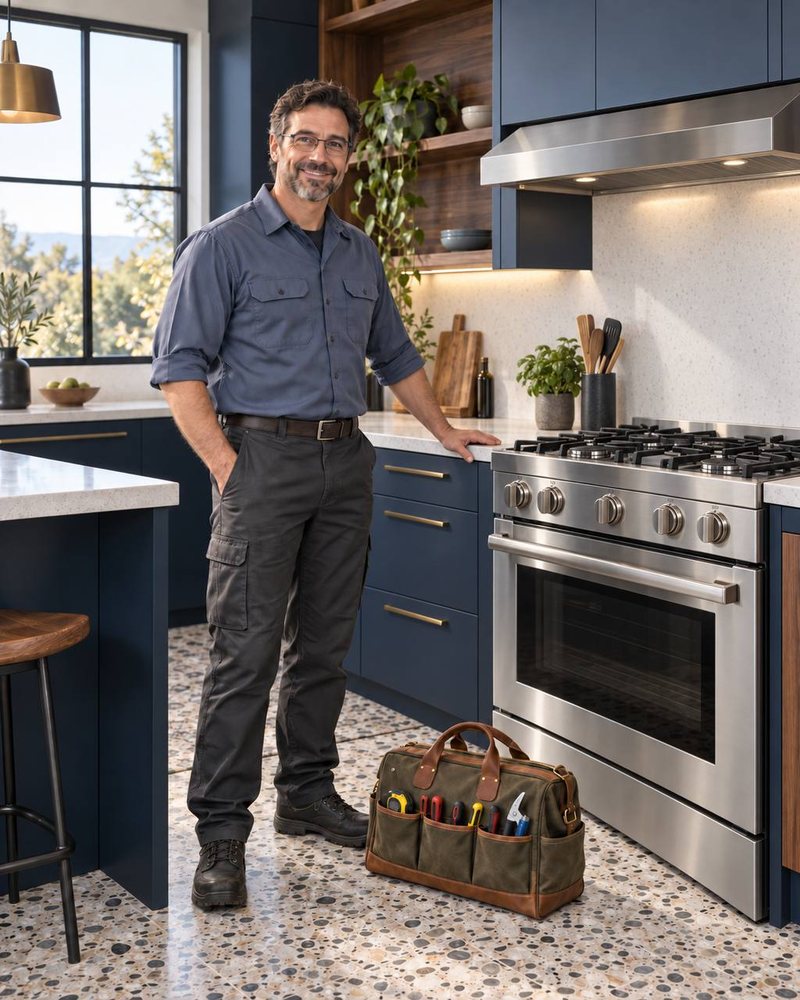
Almost no kitchen in the North End is original. The bungalows off 13th St and the Craftsman houses along Harrison Blvd have been opened up, walled back, and opened again, and the range has moved each time, sometimes onto a gas line extended by whoever was handy that decade and sometimes onto a 40-amp circuit shared with the basement. Warm Springs Ave and East End kitchens more often hold a pro-style Wolf, Thermador or Viking or a Miele wall oven set into new cabinetry inside old walls. Downtown, the condos run electric glass-tops and slide-in ranges. From the shop in Meridian we take I-84 to the Connector, get off at Myrtle or Front, come up 13th or 15th to Hyde Park or out Warm Springs Ave to the East End, and find street or alley parking.
Gas ranges fail at the igniter first. The oven's hot-surface igniter weakens over years until it glows but never draws enough current to open the valve, so the oven heats late or not at all. Surface igniters click endlessly when the spark module or a burner cap crusted with boil-over gets involved. Electric ovens lose a bake element, a temperature sensor or a relay on the control board, and glass-tops lose a radiant element or the switch behind it. One scene from the East End: a wall oven that preheats fine but drifts 40 degrees low by the second batch of cookies, which turned out to be a sensor reading high resistance on the meter.
On gas, a hot-surface igniter that glows weakly and never opens the safety valve, checked with an amp reading rather than a guess. On electric, a bake element that reads open or a relay on the board. Igniters and elements for most brands are on the truck.
A spark module that keeps firing because one switch is stuck, a cracked igniter electrode, or a burner cap sitting off-center after a scrub. We dry and reseat the caps, test each switch and the module, and replace the electrode or module that is actually at fault.
A temperature sensor drifting out of range, a convection fan that has stopped, or a bake element failing on one side. We measure the sensor's resistance, run the oven to temperature with our own thermometer and adjust or replace based on what the numbers show.
A radiant element or the infinite switch that feeds it, occasionally a burned connector at the terminal block. We test the element and switch with the meter, check the wiring behind the top for heat damage and replace the failed piece, not the whole cooktop.
F-codes on GE, Whirlpool, Frigidaire and KitchenAid ovens usually point at the sensor, the door lock on self-clean models or the control board itself. We read the code, test what it names before trusting it, and quote the real part in writing.
We treat this seriously and check it first. A lazy flame is usually a partly blocked burner port or an air shutter out of adjustment; a gas smell may be a loose fitting at a retrofitted line. We leak-test with a detector and tell you plainly if a plumber is needed.
We ask what the stove does and when, then start at the source of energy. A gas range gets a check of the supply and the regulator; an electric range gets both legs of 240 measured at the terminal block, since a North End circuit sharing a panel with the basement can drop a leg and leave the oven dead while the clock works. From there the meter goes to the part the symptom points at: igniter current, element resistance, sensor ohms, switch continuity. We show you the reading and explain what it means at the kitchen table. Then one written number, with the $99 diagnostic already inside it, and no work until you say yes.
Wolf, Thermador, Viking, Miele, Dacor and JennAir ranges and wall ovens in the Harrison Blvd and Warm Springs Ave houses are on our regular route, as are the GE, Whirlpool, Frigidaire, KitchenAid, Samsung, LG and Bosch ranges in Hyde Park kitchens and downtown condos. Landlords with rentals in the North End can have us meet the tenant and approve the quote by text; the written warranty goes to the owner. St. Luke's staff coming off nights get early windows. Pricing always comes after the diagnostic and always in writing, because a cold oven can be an igniter or a control board and the meter decides which. Decline the repair and $99 is the whole bill.
Yes. Wolf, Thermador, Viking and Miele ranges and wall ovens are regular work for us in the East End and along Harrison Blvd. Igniters, sensors and spark modules for those lines sometimes have to be ordered, and the return visit carries no second trip fee. The $99 diagnostic and written quote apply the same way.
Usually. The common causes are a temperature sensor that has drifted, a convection fan that has quit or a bake element that is failing along part of its length. We test each with the meter and confirm with our own oven thermometer. Rack position and a dark pan can add to it, and we will say so.
We repair the range and test its connection with a leak detector. If the shutoff or the line behind the wall is the problem, we tell you plainly and stop there, because that is a plumber's job. Most igniter, valve and spark repairs in North End kitchens need no work on the house line at all.
If it lights and holds a steady blue flame, yes, until we arrive. Constant clicking usually means a switch or a wet igniter, not a gas problem. If you smell gas or the flame is lazy and yellow, turn the range off at the knobs, open a window and call; we treat those first.
No. The $99 diagnostic is part of the written repair price you approve, so you never see it as an extra line. If you decide not to go ahead after hearing what failed, $99 is the whole bill for the visit to the North End.
Tell us the machine and what it is doing. We call back with a real window — and the $99 diagnostic is already inside the written price you approve.