Also on the truck
The rest of the lineup.
Same $99 diagnostic, same written quote, same written warranty on every machine we fix in Downtown & North End.
A Sub-Zero on Warm Springs Ave reading 50 degrees at breakfast, a 1990s side-by-side in a Hyde Park kitchen that clicks every few minutes, a condo fridge downtown dripping under the crispers.
Same $99 diagnostic, same written quote, same written warranty on every machine we fix in Downtown & North End.
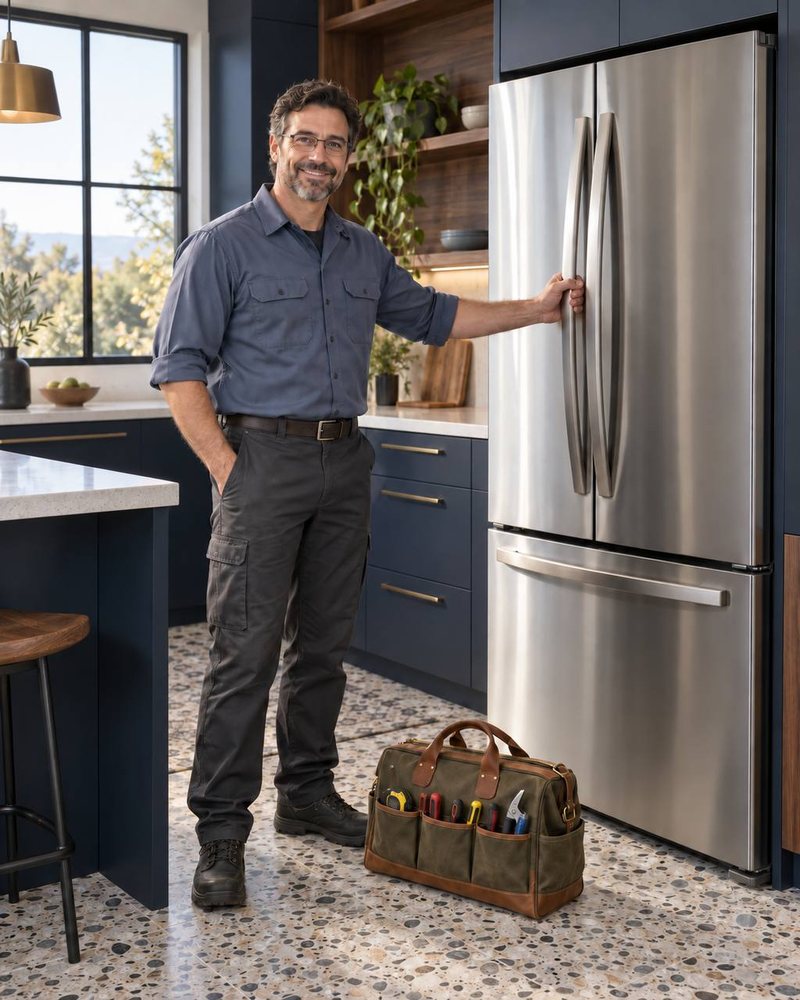
North End kitchens were remodeled in waves, and the refrigerator tells you which wave. Harrison Blvd and Warm Springs Ave houses tend to have panel-front Sub-Zero, Thermador or JennAir built-ins set into cabinetry that was measured to the eighth of an inch. Hyde Park and the streets around Camel's Back Park lean toward a good Whirlpool or KitchenAid French-door squeezed into a 1925 alcove that was drawn for an icebox. Downtown condos along Idaho St and Main St run counter-depth or apartment-size units. We drive in from our Meridian shop on I-84 and the Connector, off at Myrtle or Front and up 13th St or out Warm Springs, and we can come through the alley if the front steps are a problem.
Old kitchens run hot. A built-in with its condenser on top and a cabinet soffit closed in around it recirculates its own heat, so the compressor works harder every July and the start relay is often the first thing to go. Free-standing units pushed tight into an alcove with no side clearance do the same. Add summer dust and the pet hair that a 100-year-old floor never stops producing, and condenser coils mat over. Then there are the winter calls: a refrigerator on an unheated back porch that quits in January because the porch dropped below 40 degrees and the thermostat decided the box was cold enough.
Air is not moving between the two compartments. On most French-door and side-by-side units that is a frosted evaporator from a failed defrost heater, thermostat or control, or an evaporator fan that has stopped. We pull the back panel, test each with the meter and replace the failed part from the truck.
Compressor not running or running with no cooling. A start relay or capacitor, a condenser fan, or in the sealed-system cases a leak or a failed compressor. We measure amperage and temperatures and tell you plainly whether this is a relay or a bigger decision before you approve anything.
The compressor trying to start and tripping its overload. Common on older Hyde Park side-by-sides and on built-ins boxed into hot cabinetry. Often a relay and a coil cleaning fix it; sometimes the compressor is done and we say so at the door with the numbers on the meter to back it up.
A defrost drain frozen or clogged with the mineral crust hard city water leaves behind, or a fill line to the ice maker weeping. We clear and warm the drain, check the drain pan and the fill tube and stop the drip at its source.
Warm air getting in or a defrost cycle that stopped happening. Door gaskets on a 20-year-old built-in, a hinge that has sagged, or a defrost heater that reads open on the meter. We test the gasket seal, the heater and the defrost control and replace what failed.
A condenser fan with a worn bearing, an evaporator fan hitting frost, or a compressor mount that has cracked. Noise that stops when you open the door points to the evaporator fan. We find the source with the cabinet open and quote the part in writing.
Every warm refrigerator gets the same sequence. We listen first: is the compressor running, is the condenser fan turning, is there a click. Then a thermometer in each compartment and a clamp meter on the compressor lead. Those three readings separate an airflow problem from an electrical one from a sealed-system fault in the first few minutes, and they keep us from replacing a board when the trouble is a fan. The back panel comes off, the evaporator gets a look for frost pattern, and the defrost circuit is tested part by part. You get the name of the failed part in plain words and a single written number with the $99 diagnostic already inside it.
We repair Sub-Zero, Thermador, Viking, JennAir, Dacor and Miele built-ins on Harrison Blvd and Warm Springs Ave alongside the Whirlpool, GE, Samsung, LG, Frigidaire and KitchenAid units in the rest of the North End and in downtown condos. Built-in parts often have to be ordered; that means a return visit with no second trip fee, and we will tell you how to keep food safe in the meantime. Landlords with student and hospital-worker rentals near St. Luke's get the written quote by text while the tenant lets us in. All pricing follows the diagnostic and arrives in writing, and if you choose not to repair, $99 is the whole bill.
Same day when a window is open, and a warm refrigerator goes to the top of the list. Call in the morning and we can usually be in Hyde Park or on Warm Springs Ave that afternoon. Move what you can to a cooler, keep the doors shut, and leave the machine plugged in so we can read it running.
Yes. Sub-Zero, Thermador, Viking, JennAir, Dacor and Miele built-ins are common in the older houses along Harrison Blvd and Warm Springs Ave and in the newer downtown buildings. We service them with the same $99 diagnostic and written quote; some parts must be ordered, and the return visit carries no second trip fee.
Because the porch got colder than the refrigerator wanted to be. Below about 40 degrees the thermostat reads the box as cold enough and the compressor rarely runs, so the freezer thaws. Older units have no fix except a warmer spot; newer ones may accept a garage kit, and we tell you which you have.
Usually. Most refrigerator repairs happen from the back and the inside with the unit pulled a couple of feet forward, and the alley door is often the easier way in for a North End kitchen. If the unit is a built-in, we work from the front grille and the interior.
The visit, the meter readings, the diagnosis and a written explanation of the failed part with one repair number. That $99 is inside the repair price if you approve it. If you do not, $99 is the entire charge for our trip to Downtown Boise.
Tell us the machine and what it is doing. We call back with a real window — and the $99 diagnostic is already inside the written price you approve.