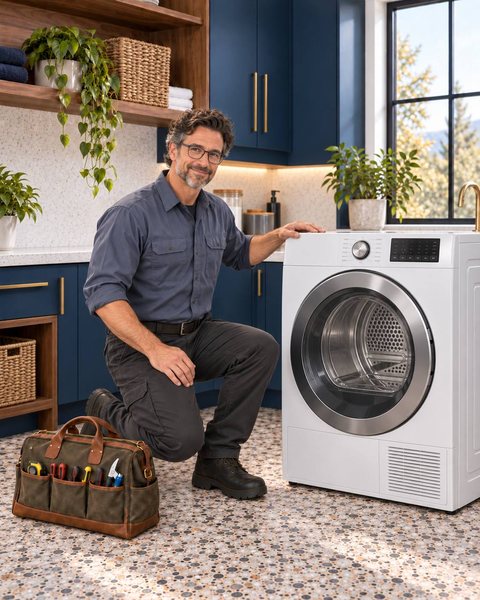
Also on the truck
The rest of the lineup.
Same $99 diagnostic, same written quote, same written warranty on every machine we fix in Boise.
A top-loader in a Bench garage that will not spin the water out, a front-loader in a Harris Ranch laundry room locked shut with a code on the screen, a basement washer in the North End that leaves a puddle every Tuesday.
Same $99 diagnostic, same written quote, same written warranty on every machine we fix in Boise.
Boise city water comes from Veolia's wells and the Boise River, and it is hard. A washer in the North End fills with it, a washer in West Boise fills with it, and a washer in a Southeast Boise subdivision off Parkcenter fills with it, week after week. The mineral collects on the inlet valve's screens and seat until fills stretch and the control gives up with a supply code. That single fact shapes more of our Boise washer work than any brand quirk. From the shop on Overland Rd just across the Meridian line we cover the whole city, east past Five Mile and Cole to the Bench, up the Connector and Harrison Blvd to the Foothills, and I-84 to Broadway for Boise State and Parkcenter.
The city's housing decides where the washer lives and how it fails. In Hyde Park and East End bungalows the washer is in a basement, so a drain hose that climbs too high or a pump that weakens shows up as slow draining long before it floods. On the Bench and in West Boise the washer sits on a garage slab that was never level, so suspension parts wear early and the machine walks. In Harris Ranch and the newer Southeast Boise streets it is a stacked or side-by-side front-load pair in an upstairs closet, where a split door boot means water through the ceiling below. We have seen each version this month.
A Boise inlet valve narrowed by scale, screens white with mineral, a kinked hose, or a solenoid that reads open. We check flow at the faucet, pull the screens, meter the coils and replace the valve only when it is the actual restriction.
A drain pump blocked by a sock, coin or hair tie, an impeller cracked loose, a clogged pump filter on a front-loader, or a hose pushed too deep into a basement standpipe. We drain it by hand, open the housing and show you what we pulled out.
A stretched belt, a worn clutch on a top-loader, a shifter actuator that no longer engages, a lid lock reading open, or a motor control board. The meter separates these quickly and most are truck stock for Whirlpool, Maytag and GE.
A torn door boot, a rusted hose clamp, a tub seal letting water past the bearing, or a dispenser overflowing from detergent and hard-water residue. We run a cycle with the panel off and find the leak while it is happening.
Broken suspension rods, tired shock absorbers, a drum bearing gone rough, or feet never set on an uneven Bench garage floor. We spin the tub for bearing noise and check every foot before we quote a part. The fix is usually the suspension, not the motor.
A door lock assembly failed, a control that never got the lock signal, or on Samsung and LG front-loaders a drain fault holding the door for safety. We read the code, release the door safely and trace the real cause behind it.
We work a washer in order because water hides the evidence. Supply first: both faucets open, hoses free, flow strong at the wall. Code second, if the machine shows one, and what the control believes went wrong. Then the meter across the inlet valve coils, drain pump, door lock and motor windings, and a hand spin of the drum to feel the bearing. On a front-loader the pump filter comes out, and in Boise it usually holds a season of grit, lint and hard-water crust. When the complaint is a leak, a short cycle with the panel off shows us the drip. Before the first cycle ends we can name the failed part plainly and hand you a single written number.
Boise laundry rooms hold Whirlpool, Maytag, Kenmore, GE, Samsung and LG most often, Speed Queen in houses that bought once for twenty years, and Bosch, Miele and Electrolux compacts in North End and Foothills remodels. The city's rental stock, from Boise State houses to Bench duplexes to Harris Ranch townhomes, means many of our washer calls run through a property manager: tenant home, written number texted to the owner, approval by reply, invoice and written warranty emailed. An ordered part means a return visit with no second trip fee. Early and late windows are held for Micron and hospital shifts. All pricing is written after the diagnostic; the $99 is inside the number you approve.
Yes. Veolia's Boise supply is hard, and every fill leaves a little mineral on the inlet valve's seat and screens. Over a few years the port narrows, fills stretch from ninety seconds to a long wait, and the control throws a supply error. Homes with a working softener see it less; homes whose softener ran dry see it fast.
We do it every week. The tenant lets us in, we diagnose, and we text the written number to the owner or property manager wherever they are. When they approve, we repair from the truck and email the invoice and written warranty. It works the same for a Boise State house or a Bench fourplex.
Usually the door boot has a split or a fold that holds grit and hard-water film until it no longer seals. Sometimes the drain path is partly blocked and water rises to the door. We run a cycle with the panel off and confirm which it is before writing the price. Upstairs laundry rooms make this one worth fixing quickly.
Drain pumps, inlet valves, door locks, lid switches, belts and suspension parts for Whirlpool, Maytag, GE, Samsung and LG ride on the truck, and West Boise and the Bench are a short run from the shop for anything else. Bearings, boards and less common parts are ordered after you approve the written price and installed on a return visit with no second trip fee.
The $99 buys the full diagnosis: supply check, code read, meter tests, drum and pump inspection, and a written price for the repair. Approve it and the $99 is part of that number. Decline and $99 is the whole bill, and you know exactly what is wrong before you shop for a replacement.
Tell us the machine and what it is doing. We call back with a real window — and the $99 diagnostic is already inside the written price you approve.