Also on the truck
The rest of the lineup.
Same $99 diagnostic, same written quote, same written warranty on every machine we fix in Boise.
A 1930s North End kitchen with a gas range that clicks and clicks, a Bench coil-top with one burner dead since spring, a Harris Ranch double wall oven throwing an F-code the night before company arrives.
Same $99 diagnostic, same written quote, same written warranty on every machine we fix in Boise.
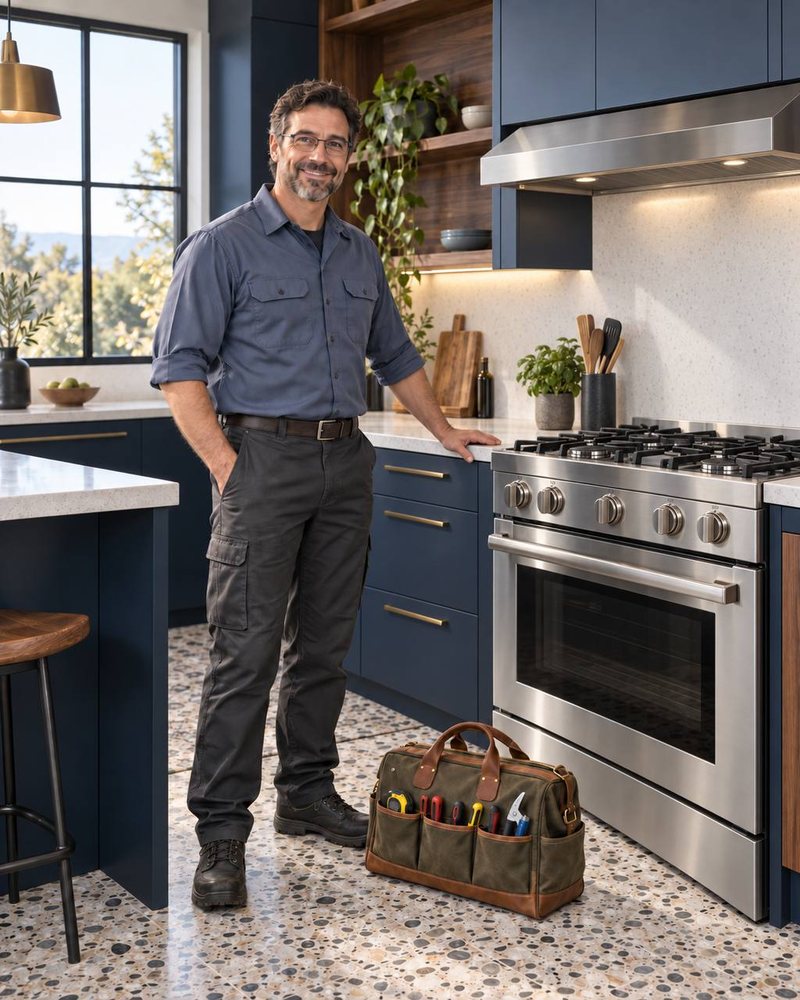
Boise kitchens span a century. Along Harrison Blvd, in Hyde Park and down Warm Springs Ave, we open gas ranges retrofitted into 1910s and 1920s footprints where the gas line comes up through an old floor. On the Bench and across West Boise, from Vista to Five Mile, the coil-top electric range is still the standard, often the original from a 1978 build. Southeast Boise, Harris Ranch and Barber Valley carry glass-top slide-ins and double wall ovens from the 2000s onward. Up in the Foothills off Bogus Basin Rd and in the East End, Wolf, Thermador and Viking ranges are common. Our trucks start on Overland Rd just across the Meridian line and reach all of it, the Bench and West Boise first, Downtown and the Foothills by way of the Connector.
Ovens in Boise fail when the weather turns. The first week the highs stay in the forties, the house fills with baking again, and the igniter that spent the summer glowing a shade too dim finally cannot draw enough current to open the gas valve. A Bench homeowner near Overland described it exactly: the burners light, the oven clicks, the smell of gas comes and goes, and the oven never warms. That is a weak igniter, not a bad valve, and the meter proves it almost at once. The part rides on the truck for the common brands, and the oven is at temperature before we pack up.
A spark igniter crusted with boil-over, a cracked insulator, a burner cap sitting crooked after cleaning, or a spark module that fires some burners and not others. We clean, re-seat and meter before replacing anything, because many of these need no part.
Gas: an igniter glowing but drawing too little current to open the safety valve. Electric: a broken bake element, an open thermal fuse, or a stuck relay on the control. We meter each and quote the one that failed; igniters and elements for major brands are truck stock.
A drifting oven sensor, a convection fan that stopped, a door gasket leaking heat on one side, or a control offset that needs correcting. We probe the actual center temperature through a preheat and compare it to the display before deciding on a part.
An open radiant element, a failed infinite switch, or a welded relay on the board. A zone stuck on is a hazard we schedule the same day anywhere in Boise. We meter the element and switch and quote the exact piece.
Codes usually point at the sensor, the door lock on a self-clean oven, a keypad with a shorted key, or the board itself. We read the code, then test the part it names instead of trusting it, and clear it only once the oven completes a full preheat cleanly.
The extreme heat of a clean cycle often finishes a tired thermal fuse or lock motor. We release the door safely, meter the fuse and lock assembly, and explain why we go easy on self-clean in an oven past its first decade.
On a range we check the house before the appliance. Electric: both legs of 240 volts at the terminal block, because a half-tripped breaker leaves the clock lit and the oven cold and sends Boise homeowners shopping for a range they do not need. Gas: the shutoff open, the flex line sound, no smell at the fittings. Then the meter reads igniter current, element resistance, the oven sensor at room temperature and each switch in turn. If the complaint is about temperature, our probe goes in the cavity through a full preheat and we compare the reading against the display. You get the failed part by name and one written number, with the $99 already counted inside it.
GE, Whirlpool, Frigidaire, Samsung, LG, KitchenAid, Maytag, Kenmore, Bosch and Electrolux ranges fill most of Boise; Wolf, Thermador, Viking, Dacor, JennAir and Miele appear in the North End, the Foothills, the East End and Harris Ranch, and we service all of them. Boise property managers send us for tenant ranges from Boise State to the Bench: tenant present, owner approves the written number by text, invoice and written warranty by email. A part on order means we return to fit it; there is no second trip fee. Early and late windows are kept open for Micron, St. Luke's and Saint Alphonsus shift workers. Nothing is priced until after the diagnostic, and if you decline, $99 is all you pay.
Almost always. A slow preheat is usually a bake element losing resistance, a gas igniter drawing too little current, or a sensor reading low. Each is a single-part repair from truck stock on most brands. We tell you in writing which it is and what the number is; if the range is not worth it, we say that too.
Yes. We service Wolf, Thermador, Viking, Dacor, JennAir and Miele ranges and wall ovens across the North End, the East End, the Foothills and Harris Ranch. Same $99 diagnostic, same meter-first method, and we bring the tools those ranges need to open without marking the finish.
Turn off the breaker for the range and call. A zone that stays on is a failed infinite switch or a welded relay, and it is a burn and fire hazard. We move these to the front of the schedule in Boise and treat them as same-day work.
Often, yes. Codes commonly point at a sensor, a door lock or a keypad, and the board gets blamed for all three. We test the part the code names with the meter, replace only what actually failed, and clear the code after the oven completes a full preheat.
We do not publish repair prices because we have not seen your range yet. The diagnostic is $99 at any Boise address, from Hyde Park to Harris Ranch. After it, you get one written number with that $99 inside; approve and we repair, decline and $99 is your entire bill.
Tell us the machine and what it is doing. We call back with a real window — and the $99 diagnostic is already inside the written price you approve.