Also on the truck
The rest of the lineup.
Same $99 diagnostic, same written quote, same written warranty on every machine we fix in Garden City.
A stacked dryer in a riverfront townhome off Adams St that has started needing two cycles, a garage unit in a 1970s house near Glenwood that spins cold, a compact electric in a Live-Work-Create loft that squeals when it starts.
Same $99 diagnostic, same written quote, same written warranty on every machine we fix in Garden City.
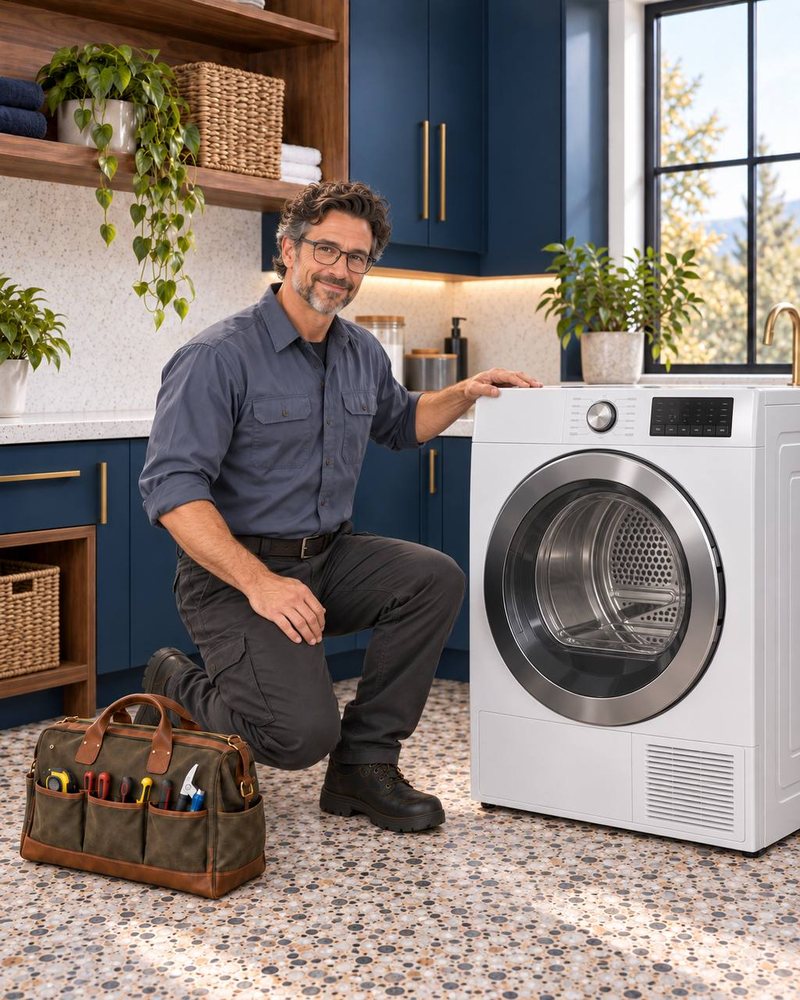
Garden City is a thin strip between Chinden Blvd and the Boise River, with more kinds of laundry room than its size suggests. Along the Greenbelt near Esther Simplot Park and Whitewater Park, the new townhomes and condos stack a compact dryer on top of its washer in a closet with a short, tight vent. Between Glenwood St and Adams St, the 1960s and 70s houses keep a full-size dryer in the garage with a long run to the outside wall. The mobile-home parks along Chinden route the vent under the floor, where it sags and fills. Live-Work-Create lofts add ventless units. Our shop is in Meridian, so this is a run up Eagle Rd and east along Chinden past Glenwood.
The complaint we hear most from Garden City is a stacked pair in a townhome that has slowed down. The dryer tumbles, gets warm, and the load still comes out damp after a long cycle. A short vent sounds like an advantage until you learn it has four tight elbows and a flap at the end that the wind off the river has stuck half shut. Lint packs the elbows, the dryer overheats a little each load, and one evening the thermal fuse opens for good. We replace the fuse, clear the elbows, free the flap and measure the airflow so the new fuse is not the next casualty.
In Garden City townhomes it is usually a thermal fuse opened by a restricted vent; in the older houses an element with a break or a gas igniter that has weakened. We meter fuse, element, igniter and thermostats and quote the single part that failed.
Airflow through a stacked closet vent with too many elbows, an exterior flap stuck shut, a blower wheel caked with lint, or moisture sensor bars coated with residue. We measure back pressure and clear the machine side on the first visit.
Drum rollers worn flat, a dry idler pulley, a cracked belt, or worn glides in a compact stacked unit. We open the cabinet, spin the drum and locate the sound. Rollers and belts for the common brands stay on the truck.
A door switch that lost its click, a failed start switch, a blown thermal fuse, a tripped half of a 240-volt breaker, or the control board. We confirm power first, then trace the circuit with the meter rather than swap parts on a guess.
Overheating from a blocked vent tripping the cycling thermostat, a motor that drops out when hot, or a control fault tied to one sensor. We run it until it stops and catch the fault in the act, because these rarely fail on command.
Lint burning against the element or burner housing, often in a mobile-home dryer with an under-floor vent that has sagged and filled. We stop it, clean the cabinet, inspect the vent path and confirm the high-limit thermostat still protects the machine.
The visit starts at the wall. An electric dryer needs both legs of 240 volts, and a double breaker with one tripped half leaves the drum turning cold, which fools nearly everyone. On a gas dryer we look at the shutoff valve and the flex connector. Then the meter reads the element, thermal fuse, both thermostats, igniter current on gas, and the door and start switches. On a stacked pair we pull the dryer forward or open the front as the design requires and spin the drum by hand to feel rollers and idler. We measure vent back pressure at the exhaust, because in a Garden City townhome closet the vent is the diagnosis half the time. Then you hear the part in plain words and get one written number.
Whirlpool, Maytag, Kenmore and Amana dryers fill the Garden City garages, alongside GE, Samsung, LG, Frigidaire and Speed Queen; the riverfront townhomes and the Live-Work-Create lofts add Bosch, Miele and Electrolux compact and ventless pairs, which we service too. Garden City has a large share of rentals and short-term units near the breweries and the Greenbelt, and landlords use us on a text: tenant or guest present, written number approved by the owner remotely, invoice and written warranty by email. When a part must be ordered, the return visit carries no second trip fee. Prices are written after the diagnostic, and a no leaves the bill at $99.
Garden City is a mid-length run from our Meridian shop, up Eagle Rd and along Chinden, so a dryer here is usually a same-week visit and often next day. A dryer that quit heating gets priority. We hold early and late windows for shift workers at St. Luke's, Saint Alphonsus and Micron.
Yes. Stacked and laundry-center units in the townhomes and condos along the Greenbelt near Esther Simplot Park are a regular call. We access the dryer as the design requires, diagnose with the meter, clear the short vent with its elbows, and write one price before any part is replaced.
We do. Mobile-home dryers vent under the floor, and that run sags and fills with lint over the years, which is why the fuse or element gives out. We repair the dryer, check what we can reach of the vent, and tell you in writing if the under-floor section needs to be cleared or replaced.
Call. A dryer fighting a restricted vent is heating its own cabinet, and the thermal fuse or element will be the next thing to go. We measure the airflow, clear the machine side and the connection, and tell you in writing whether the rest of the run needs attention.
No. The written price you approve already includes the $99, whether the dryer is in a Glenwood St garage or a riverfront condo closet. If you decide the dryer is not worth fixing, $99 is the entire bill and you keep the diagnosis.
Tell us the machine and what it is doing. We call back with a real window — and the $99 diagnostic is already inside the written price you approve.