Also on the truck
The rest of the lineup.
Same $99 diagnostic, same written quote, same written warranty on every machine we fix in Garden City.
Pint glasses from a Chinden brewery run coming out of a home dishwasher cloudier than they went in, a Bosch in a Greenbelt condo that hums and never fills, a twenty-year-old unit in an Adams St kitchen that holds water after every cycle.
Same $99 diagnostic, same written quote, same written warranty on every machine we fix in Garden City.
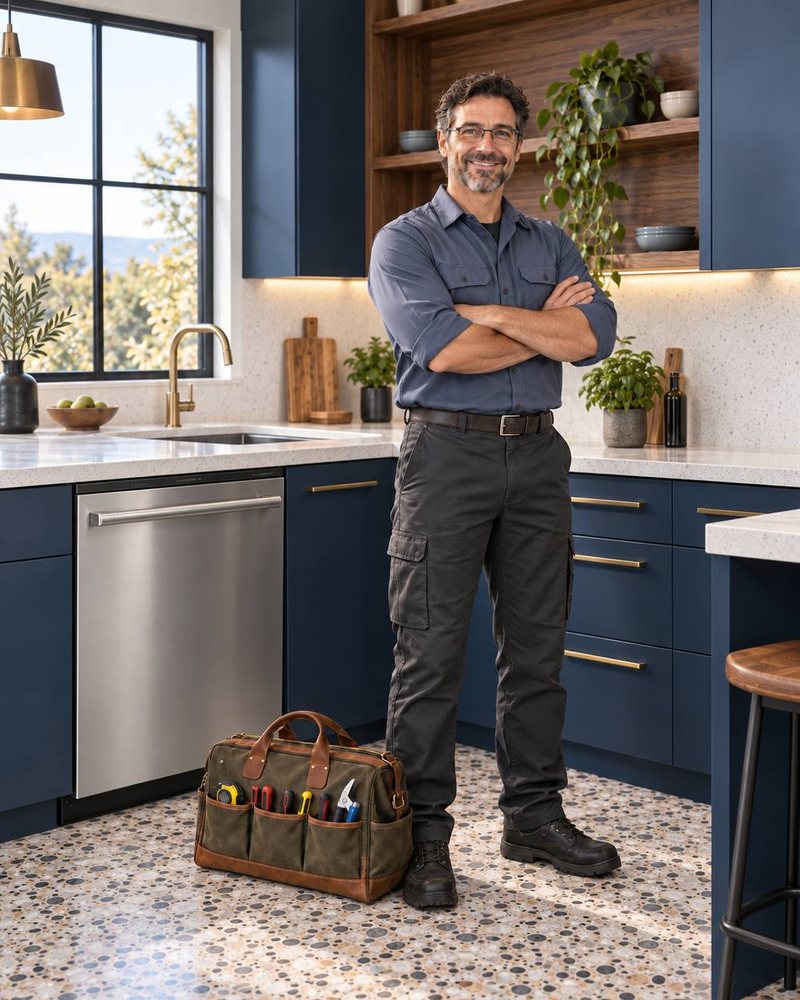
Garden City's water is hard, the same as the rest of the valley, and its dishwashers show it faster than any other appliance because they heat that water and let it dry on the parts. The machines themselves vary block by block. Riverfront townhomes and condos along the Greenbelt near Esther Simplot Park and Whitewater Park carry Bosch, KitchenAid and Whirlpool units. The 1960s and 70s houses between Glenwood St and Adams St often run a dishwasher on its second decade. Mobile-home parks along Chinden Blvd fit compact and portable units. New infill in the Live-Work-Create district adds Miele and Thermador. From our Meridian shop it is a mid-length run up Eagle Rd and east on Chinden, and all of it is regular work for us.
A Garden City dishwasher story we hear often: a couple in a Greenbelt townhome notice their glassware has turned chalky over about two months, the top rack is never quite clean, and the machine seems to run cooler than it used to. They switched detergents twice. We test the water with a strip, pull the lower spray arm and find its holes half closed with mineral, and meter a heating element wearing a white crust and reading slightly weak. The townhome has no softener at all, which is common in the newer builds along the river. We clear the arm, descale the sump, confirm the element and talk plainly about rinse aid and what a softener would change.
Hard water drying on the load, often with a heating element under scale that no longer reaches temperature. We test hardness, check the rinse-aid dispenser, meter the element and inspect it, and tell you plainly whether the machine or the water is the fix.
A drain pump jammed by glass, a pit or a label, a stuck check valve, a blocked air gap on the sink, or a drain hose without its high loop under a townhome counter. We clear the sump, run the pump and watch the water leave before calling it done.
Spray arm holes narrowed by mineral, a circulation pump losing pressure, a filter never cleaned, or an inlet valve scaled down so the tub underfills. We measure the fill against the mark and spin the arms by hand rather than guess.
A latch switch not registering closed, an opened thermal fuse, a failed control or a touchpad with a dead key. We check the latch first, meter the fuse and the control inputs, and quote only the part that actually failed.
A hardened gasket, a cracked spray arm throwing water at the seal, a loose pump clamp or an overfill from a stuck inlet valve. In a condo over another unit we run it with the kick panel off and find the drip on the first cycle.
A scaled heating element reading open, a failed vent fan on a newer model, or a rinse-aid dispenser stuck shut. In Garden City the element is the usual cause; we read its resistance and check its terminals before writing a price.
The hardness strip comes out before the screwdriver, because in Garden City the water explains half the calls. Then the door opens and we look: filter, sump, spray arm holes, the color of the element. Latch switch, thermal fuse, valve coil, drain pump, circulation pump and element each get a meter reading. If the complaint is fill or drain we run those steps alone with the kick panel off and watch. If it is cleaning we check the fill level and spin the arms. If it is film we ask whether there is a softener and when it was last filled. Before the strip has dried we usually know whether the dishwasher has failed or the water has been winning, and we write the part and one number.
Bosch, KitchenAid, Whirlpool, GE, Frigidaire, Samsung, LG, Maytag and Kenmore are most of what we open in Garden City; Miele and Thermador appear in the riverfront townhomes and the Live-Work-Create infill and we service them too. Garden City's rentals and short-term units near the breweries keep dishwasher calls coming through property managers: tenant or guest present, written price texted to the owner, invoice and written warranty by email after approval. A part we have to order means one more visit and no second trip fee. Hospital and Micron shift schedules get early and late windows. Pricing follows the diagnostic in writing, and the $99 is part of the figure you approve.
Water first, machine second. Garden City's hard water leaves mineral as the load dries. But a heating element in a coat of scale, a stuck rinse-aid dispenser or a valve that underfills makes it much worse. We check both the water and the machine and put in writing which one is to blame.
It does. Without a softener, scale builds on the spray arms and element from the first year, and glasses go cloudy sooner. We clear the scale, confirm the parts test well, and explain plainly what rinse aid, a hotter incoming supply or a softener would each change so you can decide.
Usually. Most drain failures are a jammed pump, a stuck check valve or a blocked air gap, and we clear those from the truck on the first visit anywhere in Garden City. If the pump itself has cracked and the exact part is not on board, we order it and return with no second trip fee.
Yes. Compact built-ins and portable dishwashers in the Chinden parks get the same $99 diagnostic and the same meter-first method. Low supply pressure and older drain plumbing are common there, so we check the supply and drain path before we blame the machine.
It is folded into the price rather than added to it. Once the diagnosis is done you receive a single written figure, $99 included. Approve it and we repair; decline it and $99 is the whole bill. Same rule for a Greenbelt condo, a Glenwood-area ranch or a Chinden rental.
Tell us the machine and what it is doing. We call back with a real window — and the $99 diagnostic is already inside the written price you approve.