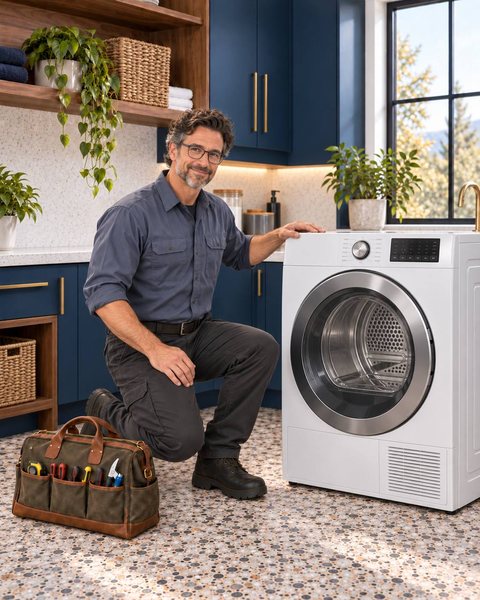
Also on the truck
The rest of the lineup.
Same $99 diagnostic, same written quote, same written warranty on every machine we fix in Eagle.
On an acre off Beacon Light Rd the washer drinks from a private well, and what comes up carries iron, sediment and enough mineral to clog an inlet screen in a season.
Same $99 diagnostic, same written quote, same written warranty on every machine we fix in Eagle.
Eagle’s washers live in two worlds. In the subdivisions along Floating Feather Rd and around Eagle Island, the water comes from the city system, hard but filtered, usually with a softener in the garage. Out toward the foothills and along the wider lots north of Beacon Light Rd, homes sit on private wells, and the water carries sediment and iron along with the mineral. Both leave their mark on inlet valves, screens and drum seals. We come straight north up Eagle Rd from our Meridian shop to Chinden and State St, and a well-water washer gets the same $99 diagnostic as a city-water one. No distance surcharge for the acreage.
The other Eagle factor is size. Bigger houses in Two Rivers and Legacy mean bigger families and bigger machines, and a large-capacity front-loader running two loads a day wears its shock absorbers, drain pump and door lock faster than the same machine in a couple’s condo. When it fails it tends to fail with an upstairs laundry room full of water. We ask about the drain pan and its outlet on every upstairs call, because a pump that quits with a full drum is a ceiling problem as much as a washer problem.
Sediment and scale in the inlet screens, or a valve narrowed inside. On Eagle well systems we also check the whole-house filter and the pressure tank setting, because low pressure produces the same code. We clean or replace the screens, test the solenoids and replace the valve when it is restricted.
The drain pump is blocked or has failed. We open the pump housing and usually find a sock, a coin or a bra wire; if the impeller is broken or the motor dead, we replace the pump. A drain hose pushed too deep into the standpipe siphons and confuses the control, so we check that.
Front-loaders stop spinning for a failed motor control board, worn bearings or a load the machine cannot balance. Top-loaders for a lid lock, a stretched belt or a bad clutch. We run the service-mode spin test, listen to the bearings and meter the motor before writing a price.
A torn door boot, a cracked pump housing, a split inlet hose or a tub seal. We run the washer and watch for the source with a light instead of guessing. On the upstairs laundry rooms common in Legacy and Banbury we also confirm the drain pan outlet is not plugged.
Shock absorbers or suspension rods have gone soft, or the machine was never leveled on the laundry room floor. A large-capacity front-loader on a second floor makes this dramatic. We replace the damping parts as a set, level the machine and check the counterweights while the cabinet is open.
The door lock assembly fails electrically and traps a wet load. We release it, meter the lock and its wiring and replace it. Codes get photographed and compared with what the meter finds, because the code is where the control gave up, not necessarily where the fault is.
We begin at the supply valves, because in Eagle the water itself is a suspect. Hoses off, screens inspected, pressure noted, and on a well system a look at the filter housing. Then the meter goes on the machine: fill valve solenoids, drain pump, motor, door lock and the control board outputs that drive them. Front-loaders run their service cycle so we see fill, wash, drain and spin under load. We look at the door boot and tub seal with a light. The fault gets named in plain words, the old part gets shown to you when there is one to show, and one written number covers the whole repair.
Eagle homes run to LG and Samsung large-capacity front-loaders, Whirlpool and Maytag top-loaders in the older Eagle Island streets, Electrolux and Speed Queen in households that shopped for longevity, and Miele or Bosch compact pairs in a few Two Rivers and Legacy laundry rooms. Pumps, valves and locks for those brands are stocked on the truck, and a part that must be ordered is installed on a return visit with no second trip fee. For landlords along Floating Feather Rd and Old State St, the tenant meets us and the written quote reaches you by text. The $99 diagnostic is built into the repair price you approve, so a declined repair costs exactly $99. All pricing is settled after the diagnostic, in writing.
It changes what we check first. Well water brings sediment and iron along with hardness, so the inlet screens and valve clog faster and the whole-house filter matters. The repair itself is the same, and so is the $99 diagnostic. We also suggest a screen check each time the filter is changed.
Turn off both supply valves, unplug the machine and mop the drain pan if it has one. Do not run another cycle to test it. When we arrive we find the source with the machine running under our control and check the pan outlet so the ceiling below stays dry.
Yes. Compact European pairs appear in Eagle’s higher-end homes and we service them, running the manufacturer’s test program to read each stage. Some parts are ordered rather than stocked, and when that happens we come back with no second trip fee and the same written warranty.
No. The foothills, the acreage north of Beacon Light Rd and everything along SH-44 are inside our normal area with no distance surcharge. It is a straight shot up Eagle Rd from our shop in Meridian to SH-44, and the $99 diagnostic is the same everywhere we go.
Then you have paid $99 and you have a written diagnosis that says exactly what failed. We will tell you plainly when a bearing or main board on an older machine does not make sense. If you do repair, the $99 is inside the written price, not added on.
Tell us the machine and what it is doing. We call back with a real window — and the $99 diagnostic is already inside the written price you approve.