Also on the truck
The rest of the lineup.
Same $99 diagnostic, same written quote, same written warranty on every machine we fix in Eagle.
Eagle laundry rooms tend to be upstairs, and the dryer vent has a long climb through the attic before it reaches a hood on the roof.
Same $99 diagnostic, same written quote, same written warranty on every machine we fix in Eagle.
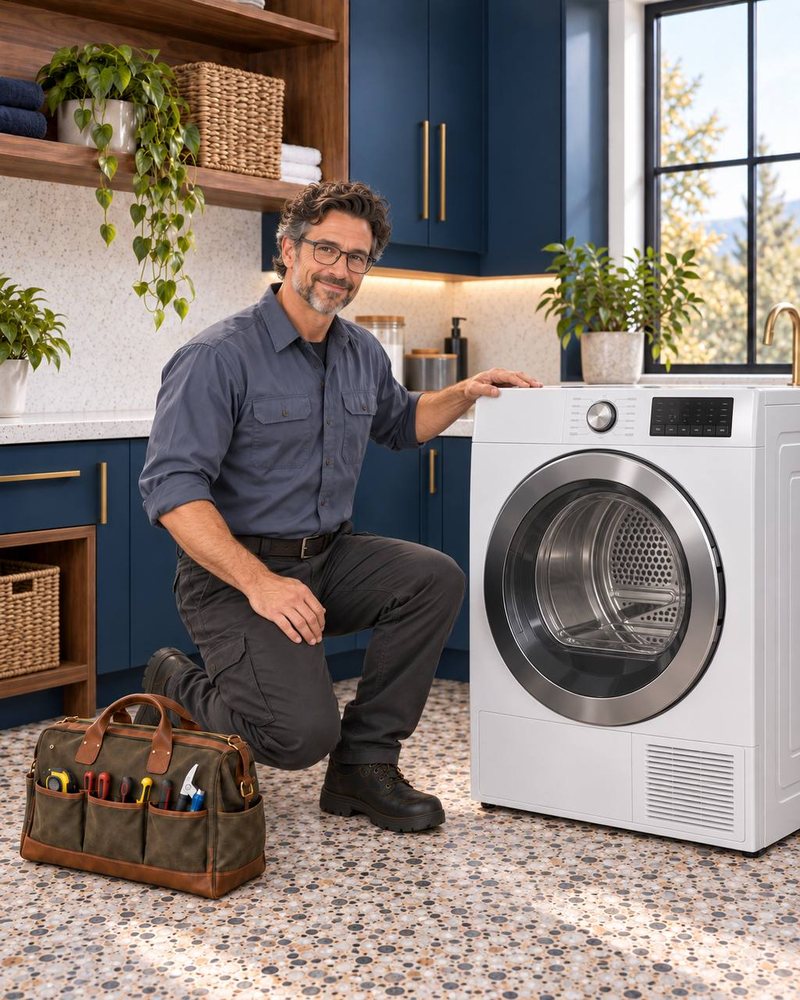
Follow Eagle Rd north from our Meridian shop, across Chinden and the river, and you are in Eagle by the time it meets State St and SH-44. The houses are bigger than the valley average, the lots are wider, and in Two Rivers, Legacy and Banbury the laundry room is upstairs next to the bedrooms. That puts the dryer a long way from any outside wall, so builders ran the vent up through the attic to a roof hood, sometimes thirty feet of duct with elbows. Dryers hate that. Every dryer visit in Eagle includes an airflow measurement at the hood, because the vent is part of the machine.
The failures are the same as anywhere, just arrived at faster. A gas dryer in a foothills home off Beacon Light Rd loses its flame because the restricted vent cooked the thermal fuse. An electric dryer in Eagle Island runs and runs while the towels stay damp, because the moisture sensor bars are coated in fabric softener and the vent is half closed with lint. A stacked pair in a Floating Feather Rd rental squeals so loudly the tenant thinks something is broken loose. It is a drum roller, and we carry them. Each call gets a meter, a plain explanation and one written number.
Electric: heating element or thermal fuse, and a blown fuse tells us the vent has been running hot. Gas: igniter, flame sensor or gas valve coils, tested in that order. We replace the failed part from the truck and then measure airflow at the roof hood, because a new fuse behind a packed attic run is a short-lived repair.
This is airflow almost every time in Eagle, where the vent climbs through the attic. We measure at the exhaust, clear the duct, check the roof hood damper for a bird nest or a stuck flap, and clean the moisture sensor bars. Then the dryer stops when the clothes are dry instead of when the timer gives up.
Worn drum rollers, a dry idler pulley or a belt with a hard spot. Upstairs laundry rooms carry the sound down the hallway, so Eagle homeowners notice early. We open the front, spin each roller, replace the set and the belt together and run a cycle until the machine is quiet.
The motor is overheating on a restricted vent, the cycling thermostat is opening early, or a door switch is bouncing. On gas models a flame sensor that drops out mid-cycle does the same. We meter the switch, thermostats and sensor while the dryer runs and quote the one that failed.
We check the outlet first: a 240-volt circuit with one leg tripped looks like a dead dryer, and garage subpanels in older Eagle homes do this. Then the thermal fuse, door switch, start switch and control board, in order. The failed piece gets named plainly, not the priciest one.
Lint is collecting where it should not: inside the cabinet around the heater or burner, or so thickly in the attic duct that the hood barely opens. We shut the dryer down, clean the interior, clear the run and check the high-limit thermostat before it runs again. This one should not wait.
Every Eagle dryer diagnosis runs the same way regardless of brand. Supply first: voltage at the outlet or gas at the valve. Then the cabinet opens and the meter goes on each part in the heat circuit, from the thermal fuse and thermostats to the element or the igniter, flame sensor and gas coils. On a machine that dries slowly we also read the moisture sensor and the motor draw. Then we walk outside or up to the attic hatch and measure airflow at the far end of the vent, because in Eagle that run is often the actual patient. You get the failed part named in plain words and one written price for the whole job.
Eagle laundry rooms lean toward LG, Samsung, Whirlpool and Maytag pairs, with Electrolux and Speed Queen in homes where the owners bought for durability and Miele compact pairs in a few of the Two Rivers and Legacy houses. Older Kenmore and GE dryers turn up in Eagle Island and the ranch homes off Floating Feather Rd. Common dryer parts for every one of those brands ride on the truck, and anything ordered comes back with no second trip fee. For landlords, the tenant meets us and the written quote goes to you by text. The $99 diagnostic belongs inside the repair price you approve, and a declined repair means $99 is the whole bill. Every number comes after the diagnostic, written down.
Because the lint screen is not where the lint is. Eagle’s upstairs laundry rooms send the vent through the attic to a roof hood, and that run collects lint and dust for years. We measure airflow, clear the duct and check the hood, and the dryer goes back to one cycle per load.
When the run needs it, yes. We clear the duct from both ends and check the roof hood damper. If we find crushed flex duct or a run that needs rebuilding rather than cleaning, we write down what we found so you can decide with the facts in front of you.
Yes. Gas dryers are common in Eagle’s larger homes and we carry igniters, flame sensors and gas valve coils. We also confirm the shutoff valve and flex connector are in good shape while the dryer is pulled out. Same $99 diagnostic, same written quote.
Yes, with no distance surcharge. Eagle is a straight shot north up Eagle Rd from our shop in Meridian, and we cover Eagle Island, Two Rivers, Legacy, Banbury, the foothills and everything along Beacon Light Rd and Floating Feather Rd.
The diagnostic is $99. It includes the supply check, meter readings on the heat circuit, an airflow measurement and the failed part named in writing with one repair price. Approve the work and that $99 is already inside the price; decline it and $99 is the whole bill.
Tell us the machine and what it is doing. We call back with a real window — and the $99 diagnostic is already inside the written price you approve.