Also on the truck
The rest of the lineup.
Same $99 diagnostic, same written quote, same written warranty on every machine we fix in Eagle.
The refrigerator in an Eagle kitchen is often a Sub-Zero or Thermador built-in, and the ice maker inside it drinks hard water, or well water carrying sediment, through a valve that closes a little every year.
Same $99 diagnostic, same written quote, same written warranty on every machine we fix in Eagle.
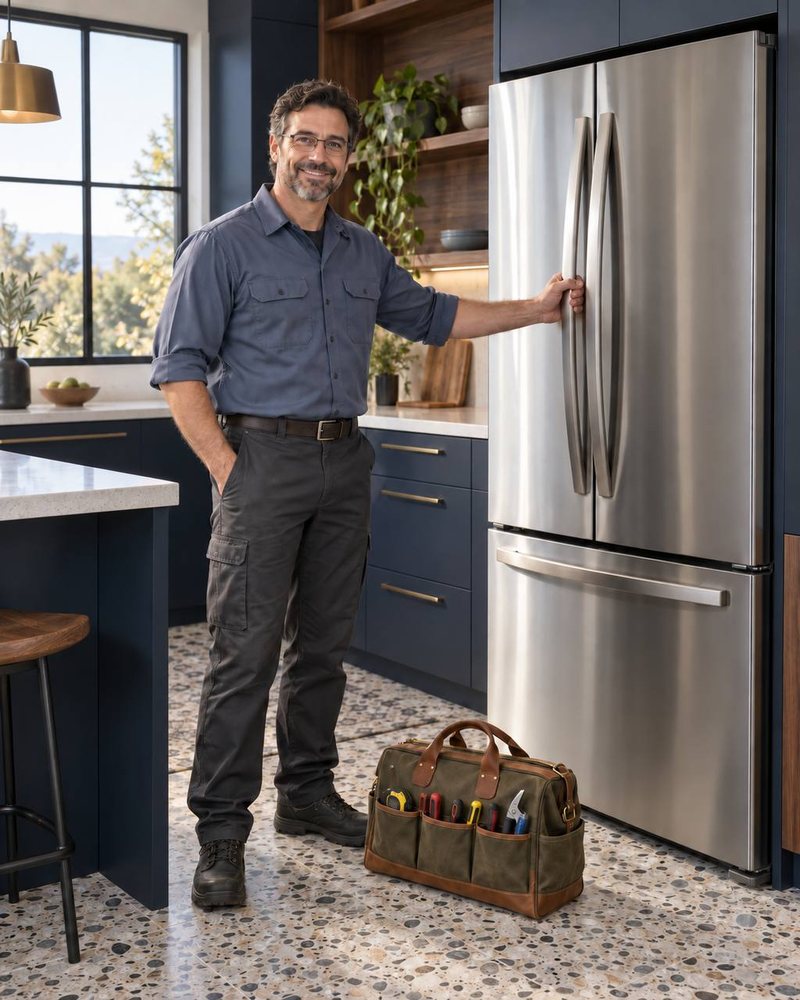
An ice maker fails at the fill valve first, and Eagle water gives it every reason. City water in Eagle Island and Banbury is hard; well water on the acreage north of Beacon Light Rd adds sediment and iron on top. Both end up as a deposit inside the valve until the tray fills short and the cubes come out hollow. In a Sub-Zero or Thermador built-in the ice maker sits in the freezer drawer and the fill valve is behind the toe grille, and the same thing happens there. We come straight up Eagle Rd from our Meridian shop, on to Chinden and State St, with valves, modules and filters, and the $99 diagnostic costs the same in the foothills as in town.
The other Eagle ice maker call is the frozen fill tube. Someone in a Two Rivers or Legacy kitchen fills the dispenser twenty times during a party, the valve dribbles between cycles, and the water freezes inside the tube where it enters the tray. After that no water arrives and the module cycles empty. Or the ejector arm jams on a cube that froze crooked and the whole ice maker sits still. Both look like a dead ice maker and neither is. We tell them apart with a meter, a light and a little patience rather than swapping the whole assembly.
We check the arm or optical sensor that tells the ice maker the bin is full, then whether water reaches the tray. No water means the fill valve, the line or a frozen tube. Water and no harvest means the module or its thermostat. Each gets a meter reading before anything is replaced.
The tray is filling short. Scale or well sediment has narrowed the fill valve, the filter is overdue, or supply pressure at the saddle valve has dropped. We measure the fill volume against spec, test the valve solenoid and check the filter date. This is the most common ice maker call in Eagle.
The valve is not sealing fully and dribbles water into the tray between cycles, or the fill tube drips. The tray overfills and freezes solid. We thaw it, replace the valve, and confirm it seals with the meter. On built-ins we also check the fill tube heater where one is fitted.
An overdue filter, old ice absorbing freezer odors, or a spill. On well water an iron taste can carry through even a fresh filter. We replace the filter, empty the bin, check the freezer temperature and gasket, and tell you in writing if the water line itself should be replaced.
The auger motor, the dispenser flap or solenoid, or ice clumped from a chute door frozen open. We test the motor and flap, clear the chute and check the door switch. On French-door units a chute door that does not seal lets warm air clump the bin every few days.
The freezer is not cold enough, the fill valve is partly scaled, or the module’s thermostat is slow to call for harvest. We check freezer temperature first, then fill volume, then cycle time. Slow ice in a built-in is often the first hint of a defrost fault elsewhere.
The ice maker has a short parts list, so we work down it in order. Freezer temperature first: a warm freezer makes no ice regardless. Then water: pressure at the supply, the filter, the fill tube and the valve, with the fill volume measured rather than eyeballed. Then the module: ejector motor, harvest thermostat, shutoff arm or optical sensor. On a Sub-Zero or Thermador built-in the ice maker lives in the freezer drawer and the valve behind the grille, so the order is the same but the panels are different. In Eagle the fill valve loses most often, and we show you the deposit inside the old one. Then one written number.
The ice makers we see in Eagle sit inside Sub-Zero, Thermador, Miele, Dacor and JennAir built-ins in Two Rivers, Legacy and the foothills, and inside Samsung, LG, Whirlpool, KitchenAid, Frigidaire and GE refrigerators in Eagle Island, Banbury and the rentals near Old State St. Common-brand valves and modules ride on the truck; built-in parts are ordered and installed on a return visit with no second trip fee. Landlords approve by text and receive the written invoice and warranty. The $99 diagnostic is wrapped into the repair price you approve, and a repair you turn down leaves $99 as the whole bill. Prices are set after the diagnostic and handed over in writing.
Yes. Sub-Zero and Thermador built-in ice makers are a regular part of our Eagle work. The valve and module are tested the same way as any other; the parts are sometimes ordered, and when they are, we install them on a return visit with no second trip fee. Same $99 diagnostic and written quote.
Well water carries sediment and iron along with hardness, and the fill valve has a very small opening. A whole-house filter and a fresh refrigerator filter slow it down; a valve that has already narrowed gets replaced. We check the filter setup and suggest a replacement interval that fits Eagle well water.
No, only the ice maker built into a refrigerator or freezer. Standalone ice machines, including under-counter units in a bar area, are a different trade. If the ice maker inside your refrigerator has stopped, jams or makes poor ice, that is ours, and we bring the parts for it.
The dual fill valve has two solenoids, one for each. The ice side can fail or scale shut while the dispenser side keeps working. We meter both and replace the valve. A frozen fill tube behind the ice maker produces the same symptom and is a simpler fix.
The $99 pays for the diagnostic: temperature, pressure, fill volume, meter readings and the failed part named with one written price. Once you approve, that $99 is already sitting inside the price. Turn it down and $99 is the whole bill, with the written diagnosis yours to keep.
Tell us the machine and what it is doing. We call back with a real window — and the $99 diagnostic is already inside the written price you approve.