Also on the truck
The rest of the lineup.
Same $99 diagnostic, same written quote, same written warranty on every machine we fix in Southeast Boise.
A 48-inch Wolf in a Harris Ranch kitchen clicks on one burner and the oven runs 35 degrees cold. A 1994 coil-top in Columbia Village has a burner that only does high.
Same $99 diagnostic, same written quote, same written warranty on every machine we fix in Southeast Boise.
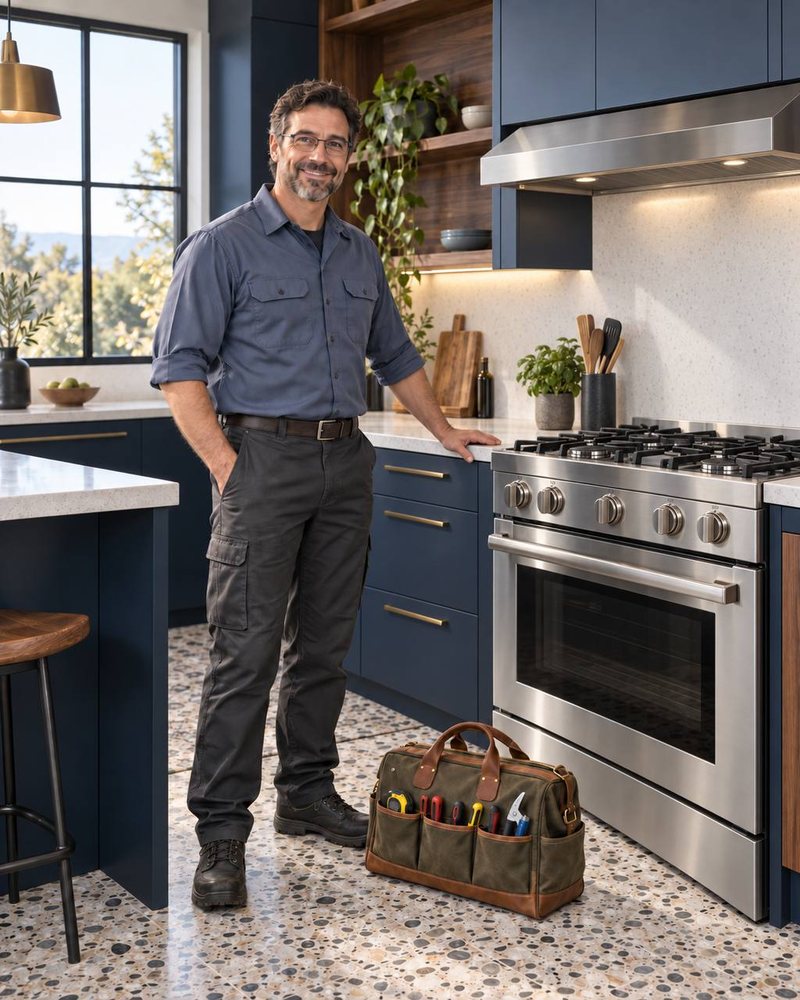
Kitchens in Southeast Boise span thirty years of taste. Harris Ranch and the Barber Valley streets built after 2005 hold pro-style Wolf, Thermador, Viking and Dacor ranges and Miele and Bosch wall ovens, often on gas that came in with the house. Bown Crossing and the Parkcenter Blvd townhomes run slide-in GE, KitchenAid and Samsung. Columbia Village and the Federal Way ranches from the 1990s keep their original coil-tops and glass-tops going with a fresh element every few years. Around Boise State, Broadway Ave and Apple St the rentals run basic Frigidaire and Whirlpool electric ranges. We reach the whole area from the shop in Meridian, east on I-84 to Broadway or Federal Way and then along Parkcenter or out Warm Springs to Harris Ranch.
Gas ranges lose their oven igniter first, a part that weakens for years before it stops drawing enough current to open the valve. Pro-style ranges add a spark module per burner bank and an oven that is fussy about its sensor. Electric ranges lose bake elements, radiant elements and the infinite switches behind them, and the older coil-tops burn a terminal block when a coil has been plugged in loose for a decade. One recent afternoon in Harris Ranch: a Thermador whose convection oven preheated to 350 and then fell back to 300 every time the fan cycled, traced with the meter to a relay board rather than the sensor the code blamed.
Gas: a hot-surface igniter drawing too little current to open the safety valve, measured with an amp clamp. Electric: a bake element reading open or a relay on the control board. Igniters and elements for the common brands ride on the truck; pro-line parts may be ordered.
A spark module firing because a switch is stuck or wet, a cracked electrode, or a cap sitting off its seat after cleaning. On a Wolf or Viking the module serves several burners, so we test each switch and the electrode before condemning the module.
A sensor reading out of range, a convection fan that has stopped, a door gasket letting heat out or a relay board cycling wrong. We measure sensor resistance, run the oven with our own thermometer and fix what the numbers show, not what the code assumes.
A burned-out element, the infinite switch behind it or a terminal block scorched from a loose coil. Common in Columbia Village and Federal Way kitchens. We test the element and the switch, inspect the block for heat damage and replace only the failed piece.
GE, Whirlpool, Frigidaire, KitchenAid and Samsung ovens throw codes for the sensor, the door lock or the board. We read the code, then test what it accuses with the meter before ordering anything, because the code is a hint and not a verdict.
Checked first, every time. A lazy flame usually means a clogged burner port or an air shutter out of adjustment; a smell may be a loose fitting at the flex line. We test with a leak detector and tell you plainly if the house line needs a plumber.
The diagnosis starts with a conversation about what the range does and when, and then goes to the supply. Gas pressure and regulator on a gas range; both legs of 240 at the terminal block on electric, since a tripped half of a double-pole breaker leaves the oven dead while the clock keeps time. Then the meter goes wherever the symptom points: igniter amperage, element and sensor resistance, switch continuity, spark output. We show you the reading and say what it means in plain words. One written number follows, with the $99 diagnostic already inside it, and nothing is touched until you approve.
Wolf, Thermador, Viking, Dacor and Miele in Harris Ranch and Barber Valley; GE, KitchenAid, Samsung, LG, Bosch and Whirlpool in Bown Crossing and the Parkcenter townhomes; Frigidaire, Whirlpool and Kenmore in Columbia Village and the rentals near Boise State. We carry the common igniters, elements, switches and sensors, and order pro-line parts with no second trip fee on the return. Landlords approve by text while the tenant is home; Micron shift workers get early and late windows. Every price comes after the diagnostic and in writing, because a cold oven can be an igniter or a board. Decline the repair and $99 is the whole bill.
Yes. Wolf, Thermador, Viking, Dacor and Miele ranges and wall ovens are regular work for us in Harris Ranch and Barber Valley. Igniters, spark modules and sensors for those lines are sometimes ordered, and the return visit carries no second trip fee. The $99 diagnostic and written quote apply the same way.
Almost always. Coil elements, infinite switches and terminal blocks for GE, Frigidaire, Whirlpool and Kenmore ranges are still made and mostly ride on the truck. The one caution is a scorched terminal block from a loose coil, which we inspect on every coil-top call in Southeast Boise before we plug a new element in.
Usually a temperature sensor that drifts under heat, a relay on the control board or a convection fan that stops mid-bake. We run the oven to temperature with our own thermometer and watch it hold, and we test the sensor's resistance hot and cold before deciding which part it is.
Not usually. A burner that clicks but lights and holds a steady blue flame has a switch or igniter problem, not a gas problem. If you smell gas or the flame is yellow and lazy, shut the knobs off, open a window and call us; those visits go to the front of the line.
You pay $99 for the diagnosis. If you approve the written repair number, that $99 is inside it, not added on top. If you decline, $99 is the whole bill and you leave knowing which part failed in your Southeast Boise kitchen.
Tell us the machine and what it is doing. We call back with a real window — and the $99 diagnostic is already inside the written price you approve.